
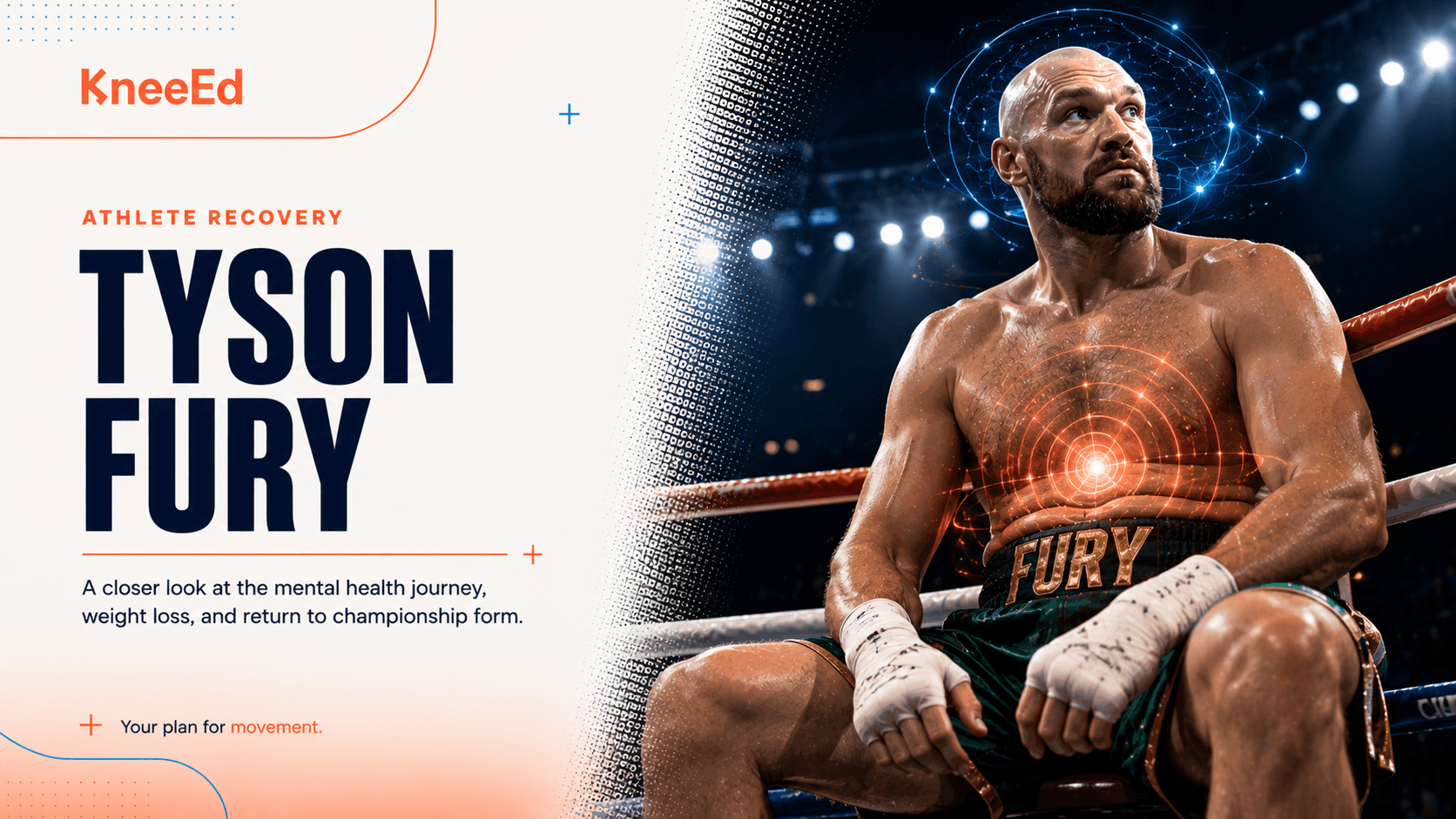
On November 28, 2015, in a half-empty arena in Dusseldorf, Tyson Fury out-boxed Wladimir Klitschko over twelve rounds and took the unified heavyweight championship of the world. It was the thing he had wanted since he was a boy. He had ended a title reign that had lasted nearly a decade. He flew home to England as the lineal heavyweight champion, with a wife, three children, money, and the one trophy that had defined his entire life.
Within roughly six months, he later said, he was waking up every morning praying for death.
What happened next was not a boxing story. It was a mental-health story that happened to involve a boxer. Fury was diagnosed with bipolar disorder, drank seven days a week, used cocaine for months, and at his heaviest weighed somewhere between 400 and 450 pounds. One afternoon in the summer of 2016 he drove a Ferrari at high speed toward a bridge, fully intending to crash it, and pulled back at the last possible moment. The recovery that followed is the part worth studying, because it is the part that is repeatable.
The collapse nobody scheduled
The detail that matters most about Fury's collapse is the timing. He did not break down after a loss, a scandal, or a career-ending injury. He broke down after the single greatest achievement of his life. That sequence is the whole point. Depression did not arrive because something went wrong on the outside. It arrived while everything on the outside was, by any external measure, exactly right.
In the months after Dusseldorf there was no rematch and no clear next fight. The structure that had organised every day of Fury's adult life, the camp, the diet, the count toward a fight night, simply evaporated. Into that vacuum came a low he could not explain and could not argue himself out of. He stopped training. He started drinking, by his own account, seven days a week, and using cocaine. Over a matter of months his weight climbed past 400 pounds. His boxing licence was suspended on October 13, 2016, citing anti-doping and medical issues, and the man who had been champion of the world less than a year earlier was, functionally, no longer a fighter.