
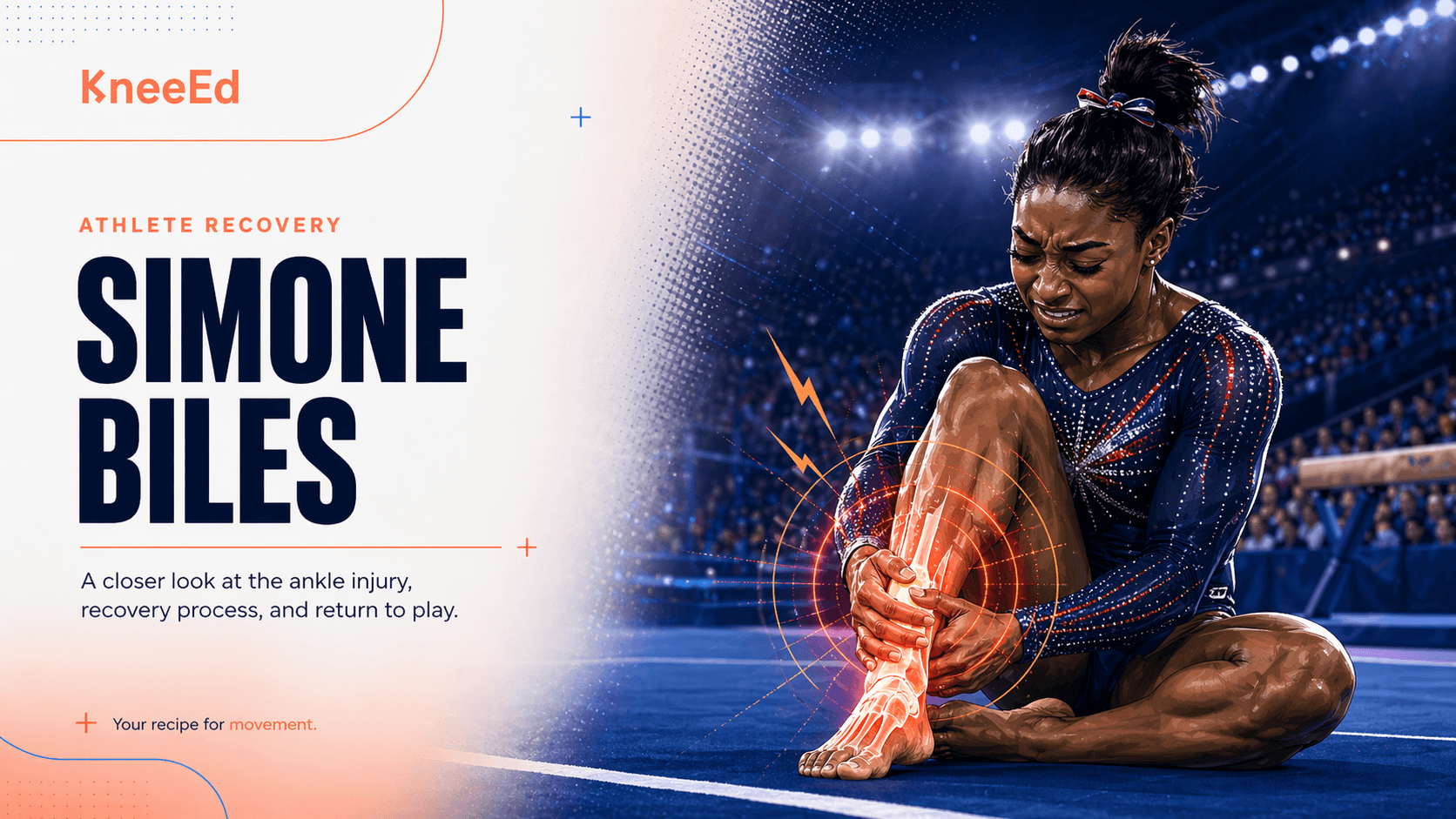
Editorial illustration of Simone Biles seated on a gymnastics floor with the KneeEd wordmark and a coral motion glow tracing her lower leg and calf.

The Four Minutes That Decided a Calf

How Simone Biles and her team managed an active calf strain across the Paris team final, event by event, instead of recovering from it afterward.

KneeEd editorialUpdated June 7, 202612 min read

Most calf-strain stories are recovery stories. Someone tears a few fibers, the leg gets rested, the tissue knits, and weeks later the athlete is back. The Simone Biles story from Paris is the rarer kind. She did not recover from the strain and then compete. She competed on it, in real time, with a medical team reading the leg between rotations, and only began recovering once the meet was over and the boot went on.

She felt the calf go in warm-ups, and roughly four minutes later she was on the vault runway anyway.

What happened in those four minutes, and across the four rotations that followed, is the closest most people will come to watching live sports medicine make a high-stakes call. This is what the leg was actually doing, what the team did about it, and where the line sits between her situation and yours.

What actually tore

Start with the tissue, because the whole decision rests on it. The calf is two muscles stacked over the same tendon. The gastrocnemius is the bigger, more visible one, and it crosses both the knee and the ankle, which makes it the muscle that handles explosive, springy demands like jumping and vaulting. The soleus sits underneath it, crosses only the ankle, and does the quieter, longer endurance work. Both feed into the Achilles tendon, which is where the landing forces ultimately concentrate.

Biles aggravated her left calf on July 28, during warm-ups for the qualifying round, on floor. She had history in that leg. In the weeks of training before Paris she had hyperextended the same knee and dealt with a prior calf-muscle issue in the same leg, so the tissue was not arriving fresh. Her coach told reporters afterward that she felt a little pain in her calf during warm-ups, that the injury was minor, and that there were no plans to sideline her. The later Netflix documentary, Simone Biles Rising, framed it more bluntly as a strain slash tear, and revealed that in the moment Biles feared something far worse: an Achilles rupture, the catastrophic version of this injury, the one that ends seasons.

Choose your KneeEd membership to keep reading.

Your first Pro story is on us. After that, Pro stories are part of Plan Club Pro.

Your one free Pro story, on us.

or go unlimited

You can cancel anytime.

Already a member? Sign In

New to KneeEd? Create your KneeEd Account

When to stop reading and get help

Call your emergency number now

911 in the United States and Canada, 999 or A&E in the United Kingdom, 112 across the European Union. If any of the following is happening, that call comes before anything else on this page.

  • Pain, tingling, weakness or numbness in both legs, a loss of feeling around your genitals or anus, difficulty peeing, losing control of your bladder or bowels, or a change in how sex feels. Together with back pain these are the signs the NHS puts in its emergency tier.
  • Chest pain, or breathlessness, especially alongside pain and swelling in one calf or thigh.
  • Pain that started after a serious accident, such as a car crash.

Get advice the same day

An urgent care clinic or your own doctor, NHS 111 in the United Kingdom. Same day, not next week.

  • A joint that is suddenly severely painful, hot, swollen, or red, that you cannot move or put weight on, particularly with a high temperature. Not everyone with an infected joint has a fever.
  • Throbbing pain and swelling in one leg, usually the calf or thigh, with skin that looks red, blue or darker than usual.
  • Severe pain that starts suddenly or is getting worse quickly, or feeling hot, cold, shivery or generally unwell with it.

None of this is medical advice. KneeEd is not a medical provider and nothing on this page is a diagnosis, a treatment, or a substitute for an assessment by a clinician who can examine you. Talk to a healthcare professional before starting or changing any rehabilitation programme, and stop if something gets worse. If something feels wrong in a way this page does not describe, that is a reason to be seen, not a reason to read more.

Sources for this block, accessed September 2026: NHS · Back pain, NHS · Septic arthritis, NHS · Deep vein thrombosis. The clinical signs come from the NHS, which publishes them plainly and keeps them current. The numbers above are written for the reader rather than for the source: most of this audience is in the United States, so the emergency tier leads with 911 and names the NHS lines as the United Kingdom equivalents, matching how the rest of the product states it.