
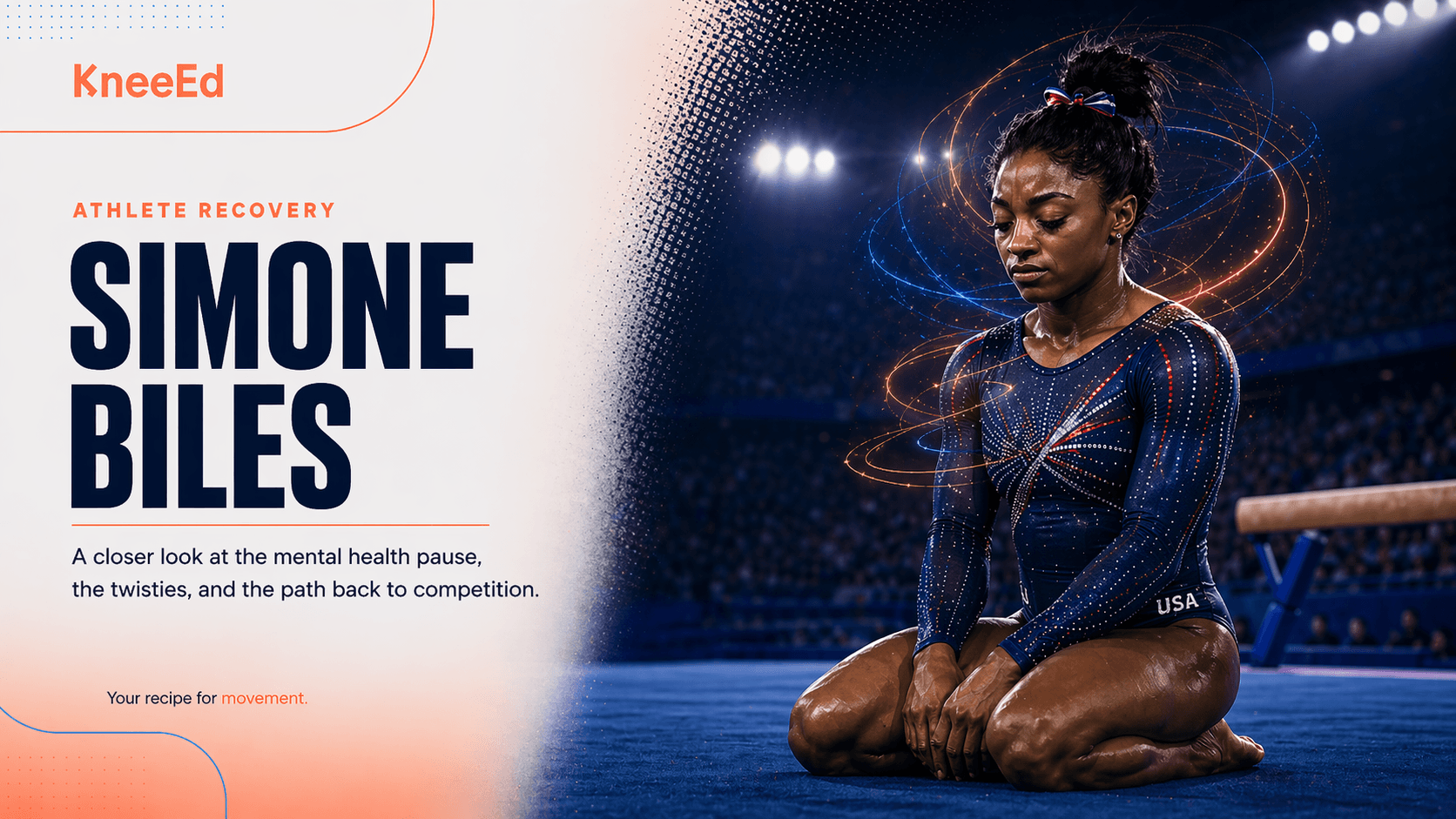
Editorial illustration of Simone Biles mid-air in her competition leotard with the KneeEd wordmark and a coral and blue motion glow tracing her rotation.

Simone Biles: No Idea Which Way Was Up

The twisties are not a nerve failure or a confidence problem. They are the brain pulling the emergency brake. A closer look at the science, the roughly two-year recovery nobody could schedule, and why physical health is mental health.

KneeEd editorialUpdated June 7, 202614 min read

On July 28, 2021, during a vault warm-up at the Tokyo Olympics, Simone Biles left the table for a Yurchenko double pike, a skill she had landed thousands of times, and her brain lost track of where her body was. She came down on her back instead of her feet. Moments later she withdrew from the team final, and then from all four individual finals: all-around, vault, beam, and floor. She had not torn a ligament. She had not failed a test. What had failed was something most people never have to think about, the brain's real-time sense of itself in space.

Literally cannot tell up from down. It's the craziest feeling ever. Not having an inch of control over your body. What's even scarier is since I have no idea where I am in the air I also have NO idea how I'm going to land, or what I'm going to land on.
Simone Biles, July 2021

Gymnasts call it the twisties. The name is almost too small for what it is. It is not nerves and it is not a confidence dip you can will your way through. It is a genuine breakdown in the brain's motor control, the same circuitry that lets you touch your nose with your eyes closed, scaled up to a body rotating at speed several feet off the ground. The recovery that followed had no clean clinical label and no schedule. It ran about 22 months, and it changed how elite sport talks about the line between mental and physical health.

The recovery that nobody could schedule

Start with what the recovery actually was, because the popular version gets it backward. The story is usually told as if Biles took some time off, got her head right, and came back. That is not what happened. What happened was a long, structured, professionally supported program of rebuilding two systems at once, the psychological and the physical, because in her case they were never two separate things. The work was led by her coaches, the married coaching team Cecile and Laurent Landi, who had guided her since 2017, and it was anchored by weekly therapy that did not pause when the cameras left.

She did not rush a return to the apparatus. For most of 2022 she stepped back from intensive training entirely. A graduated return began around September 2022, roughly fourteen months of minimal training before she was even building toward real volume. Two-a-day sessions resumed in January 2023. Only after her April 2023 wedding did she commit to full-force preparation. The August 2023 competition return came at the end of a deliberate, phased ramp, not at the front of a comeback narrative.

Choose your KneeEd membership to keep reading.

Your first Pro story is on us. After that, Pro stories are part of Plan Club Pro.

Your one free Pro story, on us.

or go unlimited

You can cancel anytime.

Already a member? Sign In

New to KneeEd? Create your KneeEd Account

When to stop reading and get help

Call your emergency number now

911 in the United States and Canada, 999 or A&E in the United Kingdom, 112 across the European Union. If any of the following is happening, that call comes before anything else on this page.

  • Pain, tingling, weakness or numbness in both legs, a loss of feeling around your genitals or anus, difficulty peeing, losing control of your bladder or bowels, or a change in how sex feels. Together with back pain these are the signs the NHS puts in its emergency tier.
  • Chest pain, or breathlessness, especially alongside pain and swelling in one calf or thigh.
  • Pain that started after a serious accident, such as a car crash.

Get advice the same day

An urgent care clinic or your own doctor, NHS 111 in the United Kingdom. Same day, not next week.

  • A joint that is suddenly severely painful, hot, swollen, or red, that you cannot move or put weight on, particularly with a high temperature. Not everyone with an infected joint has a fever.
  • Throbbing pain and swelling in one leg, usually the calf or thigh, with skin that looks red, blue or darker than usual.
  • Severe pain that starts suddenly or is getting worse quickly, or feeling hot, cold, shivery or generally unwell with it.

None of this is medical advice. KneeEd is not a medical provider and nothing on this page is a diagnosis, a treatment, or a substitute for an assessment by a clinician who can examine you. Talk to a healthcare professional before starting or changing any rehabilitation programme, and stop if something gets worse. If something feels wrong in a way this page does not describe, that is a reason to be seen, not a reason to read more.

Sources for this block, accessed September 2026: NHS · Back pain, NHS · Septic arthritis, NHS · Deep vein thrombosis. The clinical signs come from the NHS, which publishes them plainly and keeps them current. The numbers above are written for the reader rather than for the source: most of this audience is in the United States, so the emergency tier leads with 911 and names the NHS lines as the United Kingdom equivalents, matching how the rest of the product states it.