
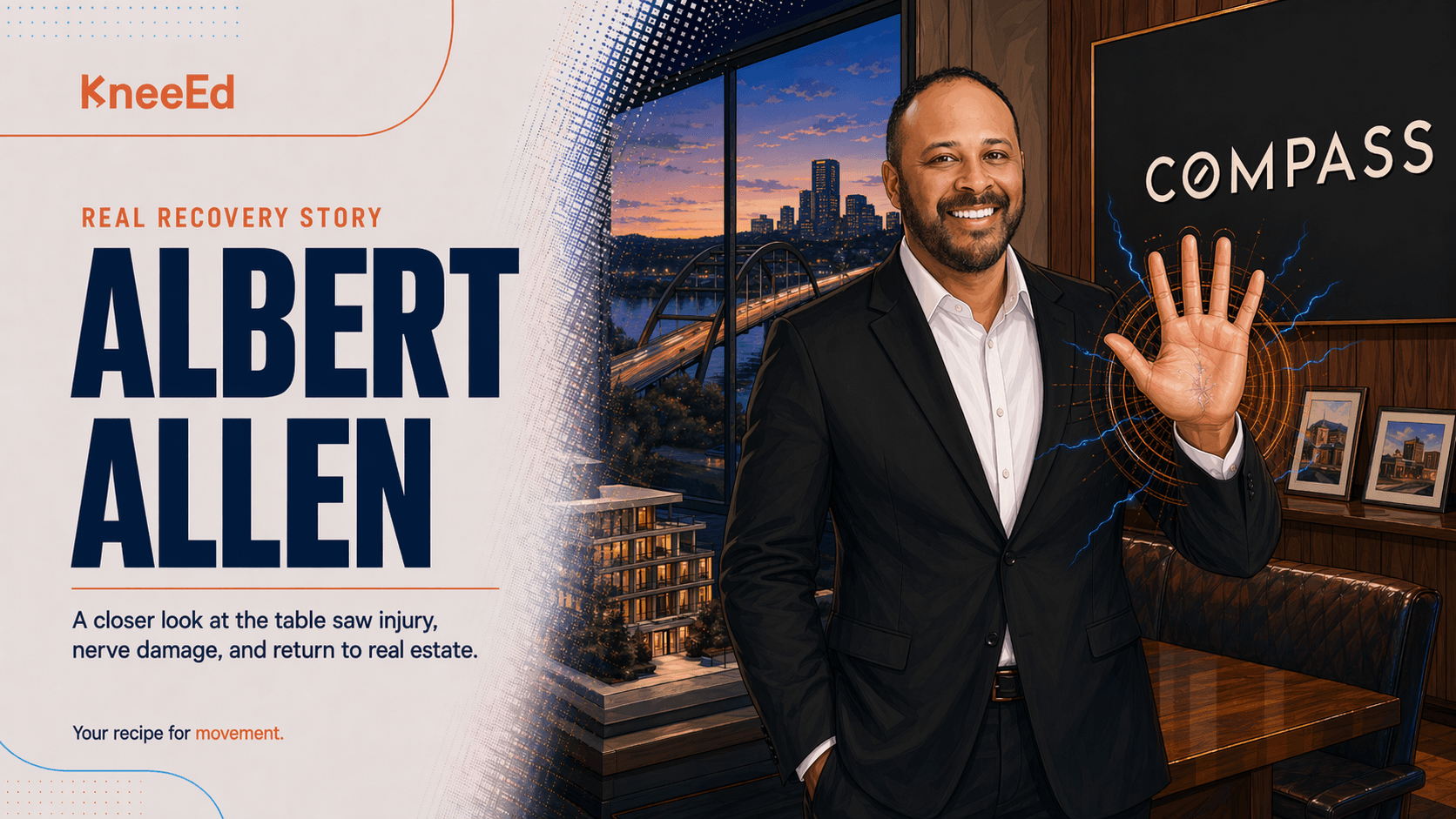
Editorial illustration of Albert Allen in his Compass real estate office with the KneeEd wordmark and electric blue motion glow at the left hand.

Albert Allen: A Hand and a Career on the Same Schedule

A closer look at a mid-career table saw injury, the long arc of nerve recovery, and the return to a job that is paid in handshakes.

KneeEd editorialUpdated April 25, 20264 min read

Albert Allen is a Compass realtor in Austin. His job is paid in handshakes, signed contracts, walking properties, and the small dexterity work most people take for granted, pulling lockboxes, marking up floor plans, framing a photograph for a listing. None of those tasks survive losing the use of a hand.

An afternoon in his garage with a table saw took the left hand offline for the better part of a year.

The recovery story is, in the broad strokes, the same one most weekend woodworkers face. The lesson is in the parts that come back, and the parts that do not.

A note on where this comes from, because the two halves of it are sourced differently. Albert told us what happened to his hand, and he agreed to this piece being written about it. Everything personal here is his account: the afternoon, the surgery, the months, the scar he still cannot feel. Everything clinical sits beside it from the published literature, cited at the foot of the page. Where the two disagree, his account is what happened to him, and the literature is what usually happens to everyone else.

The cut

Table saw injuries are, statistically, one of the most common ways an adult ends up in an emergency room with a hand wound. They share a profile: a slip in attention, a kickback or a hand-meets-blade sequence, a quick trip to the ER, and, for the more serious cases, a hand surgeon who meets the patient that night.

The first 48 hours of a major laceration are about damage control: cleaning, repair of any severed tendons or nerves, and immobilization. The first six weeks are about staying out of the way of the body's own repair process. The work, for the patient, has not really started yet.

Choose your KneeEd membership to keep reading.

Your first Pro story is on us. After that, Pro stories are part of Plan Club Pro.

Your one free Pro story, on us.

or go unlimited

You can cancel anytime.

Already a member? Sign In

New to KneeEd? Create your KneeEd Account

When to stop reading and get help

Call your emergency number now

911 in the United States and Canada, 999 or A&E in the United Kingdom, 112 across the European Union. If any of the following is happening, that call comes before anything else on this page.

  • Pain, tingling, weakness or numbness in both legs, a loss of feeling around your genitals or anus, difficulty peeing, losing control of your bladder or bowels, or a change in how sex feels. Together with back pain these are the signs the NHS puts in its emergency tier.
  • Chest pain, or breathlessness, especially alongside pain and swelling in one calf or thigh.
  • Pain that started after a serious accident, such as a car crash.

Get advice the same day

An urgent care clinic or your own doctor, NHS 111 in the United Kingdom. Same day, not next week.

  • A joint that is suddenly severely painful, hot, swollen, or red, that you cannot move or put weight on, particularly with a high temperature. Not everyone with an infected joint has a fever.
  • Throbbing pain and swelling in one leg, usually the calf or thigh, with skin that looks red, blue or darker than usual.
  • Severe pain that starts suddenly or is getting worse quickly, or feeling hot, cold, shivery or generally unwell with it.

None of this is medical advice. KneeEd is not a medical provider and nothing on this page is a diagnosis, a treatment, or a substitute for an assessment by a clinician who can examine you. Talk to a healthcare professional before starting or changing any rehabilitation programme, and stop if something gets worse. If something feels wrong in a way this page does not describe, that is a reason to be seen, not a reason to read more.

Sources for this block, accessed September 2026: NHS · Back pain, NHS · Septic arthritis, NHS · Deep vein thrombosis. The clinical signs come from the NHS, which publishes them plainly and keeps them current. The numbers above are written for the reader rather than for the source: most of this audience is in the United States, so the emergency tier leads with 911 and names the NHS lines as the United Kingdom equivalents, matching how the rest of the product states it.