
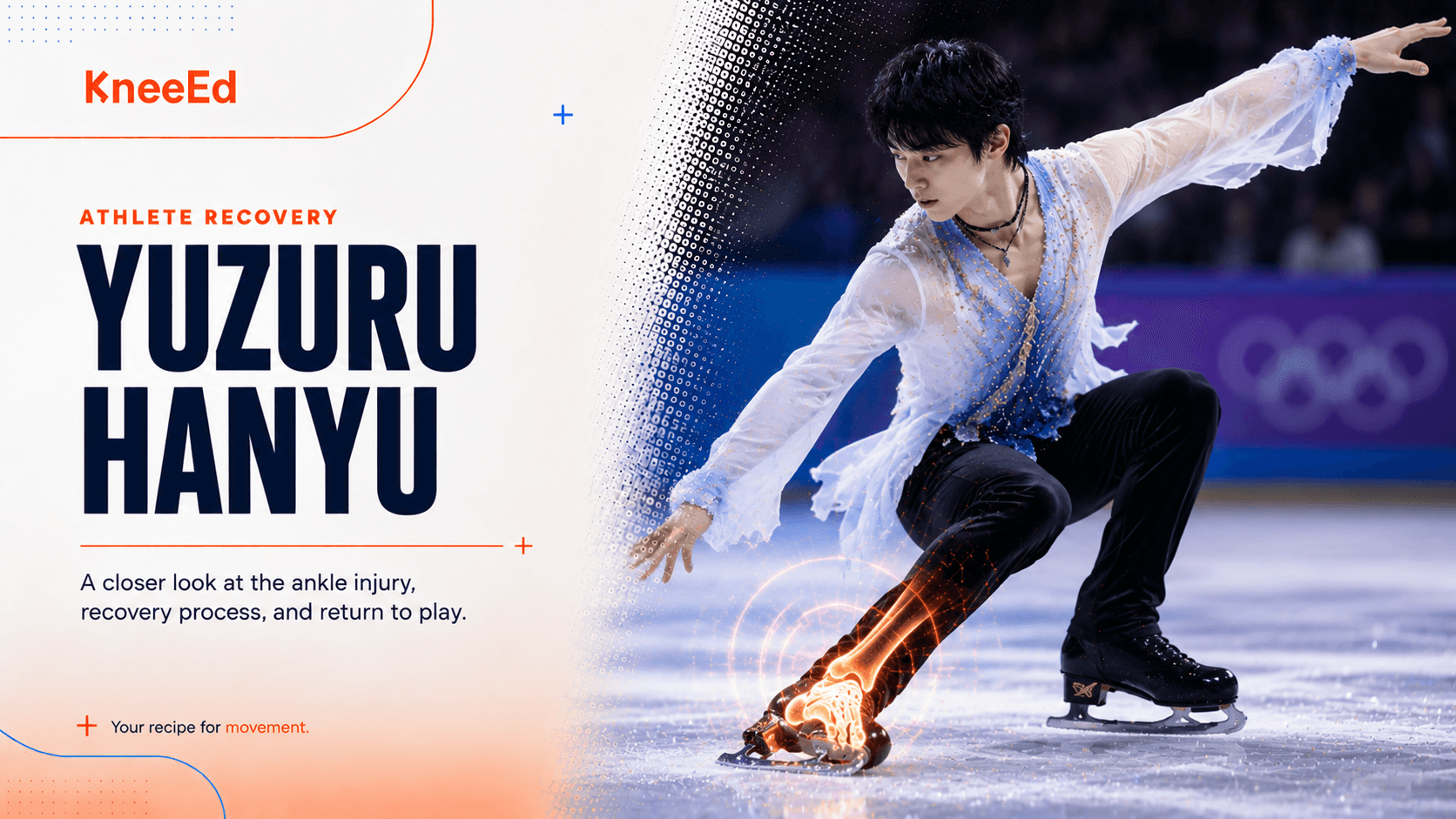
On November 9, 2017, three months before the Winter Olympics, Yuzuru Hanyu came down from a quadruple Lutz in practice at the NHK Trophy in Osaka and landed wrong. By one account he did the equivalent of the splits. The force rolled the foot inward past everything meant to hold it, and the lateral ligaments on the outside of his right ankle gave way. He was the defending Olympic champion and the most artistically gifted figure skater of his generation, and the jump that hurt him is one a skater lands on exactly that ankle, thousands of times a year, with the whole body channeled through a single blade.
He won the gold anyway, becoming the first man in 66 years to win back-to-back Olympic figure skating titles, and he later admitted he could only attempt the jumps because a pain-killing injection had removed the feeling from the ankle.
It is one of the great competitive performances in the history of the sport. It is also a story about what it costs to compete through an injury rather than recover from it. The most useful thing in it is not the medal. It is the bill the ankle kept presenting for years afterward, and what that bill teaches anyone with a sprained ankle and a deadline.
The jump that lands on the injury
A figure skater's ankle is not like a runner's or a footballer's. Every landing puts the body's full weight, multiplied by the speed of rotation, through one ankle and one thin blade, on ice, hundreds of times a session. The lateral ligaments on the outside of that ankle are the structures that keep it stable through the twisting impact. When Hanyu tore them in November 2017, he had injured the exact tissue his sport asks the most of, on the exact side it lands on.