
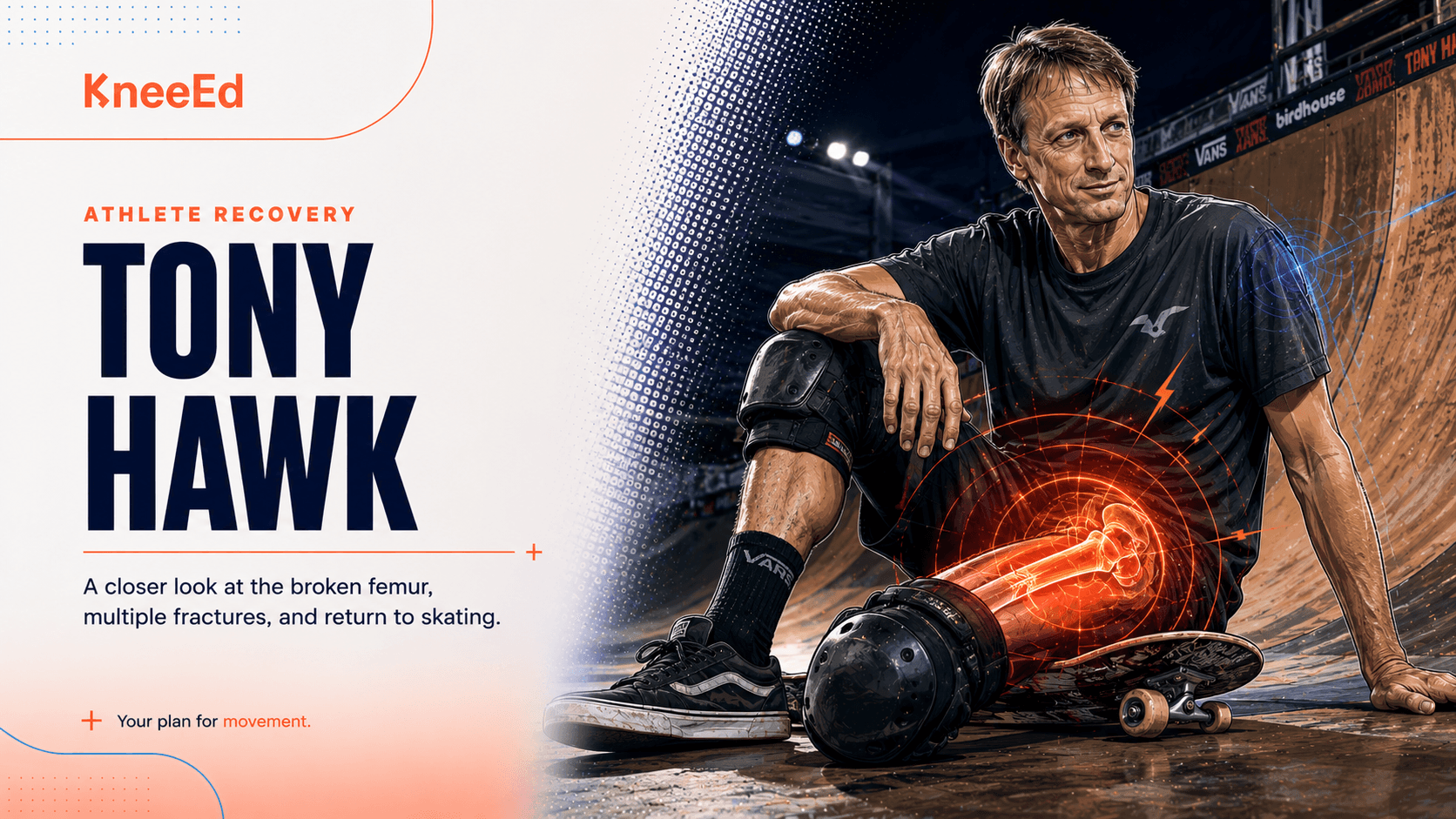
Editorial illustration of Tony Hawk seated beside a skateboard at the base of a vert ramp in a dark shirt and knee pads, with the KneeEd brand wordmark and a coral motion glow tracing the femur of his lower leg.

Tony Hawk: The Femur That Wouldn't Be Rushed

He broke the strongest bone in his body at 53, skated again two weeks later, and learned the hard way that walking is not the same as healing. A close look at the fracture, the rod that fixed it, the comeback he rushed, and the second surgery it cost him.

KneeEd editorialUpdated June 8, 20267 min read

In March 2022, on a vert ramp he had skated ten thousand times, Tony Hawk caught an edge and went down, and the femur in his leg snapped. He was 53 years old. The femur is the largest and strongest bone in the human body, the long bone of the thigh, and breaking one is not a sprain or a tweak. It is a major orthopedic event, the kind of force usually associated with car crashes, that ends with surgery and a metal rod. Hawk, being Hawk, was filming himself skating again two weeks later. That is where this story gets interesting, and where it stops being a highlight reel.

Skating two weeks after a broken femur is not a triumph of toughness. It is the exact mistake that turned one surgery into two, and Hawk has been honest that it almost cost him the leg's full recovery.

He later called it the most traumatic injury of his life. Not because the break itself was unusual, femurs heal, the surgery is routine, but because of what he did next. He confused being able to stand with being healed, pushed a body that was not ready, and spent months in denial about the pain that was trying to tell him something. This is a story about a fracture. It is mostly a story about the difference between walking and healing, and the price of ignoring it.

The break

Start with the bone, because its size is the whole point. The femur runs from the hip to the knee and is built to carry the entire load of the body through every step, jump, and landing. It is encased in the largest muscle mass in the body, the quadriceps and hamstrings, and it is engineered to take enormous force. That strength is exactly why a femoral shaft fracture is such a serious injury: the force required to break a healthy adult femur is immense, and the same muscles that protect it then pull on the broken ends, which is why these fractures almost always need surgical fixation rather than a cast.

For an aging athlete in a high-impact sport, the mechanism is not mysterious. Vert skating is a sport of repeated hard landings and high falls onto a wooden ramp. A bad fall transfers that energy through the leg in a fraction of a second. Hawk had broken bones before, an elbow, a pelvis, teeth, fingers, the ordinary accounting of four decades on a skateboard, but the femur was a different order of magnitude. It is the injury that makes a 53-year-old stop and ask whether the body can still cash the checks the sport keeps writing.

Choose your KneeEd membership to keep reading.

Your first Pro story is on us. After that, Pro stories are part of Plan Club Pro.

Your one free Pro story, on us.

or go unlimited

You can cancel anytime.

Already a member? Sign In

New to KneeEd? Create your KneeEd Account

When to stop reading and get help

Call your emergency number now

911 in the United States and Canada, 999 or A&E in the United Kingdom, 112 across the European Union. If any of the following is happening, that call comes before anything else on this page.

  • Pain, tingling, weakness or numbness in both legs, a loss of feeling around your genitals or anus, difficulty peeing, losing control of your bladder or bowels, or a change in how sex feels. Together with back pain these are the signs the NHS puts in its emergency tier.
  • Chest pain, or breathlessness, especially alongside pain and swelling in one calf or thigh.
  • Pain that started after a serious accident, such as a car crash.

Get advice the same day

An urgent care clinic or your own doctor, NHS 111 in the United Kingdom. Same day, not next week.

  • A joint that is suddenly severely painful, hot, swollen, or red, that you cannot move or put weight on, particularly with a high temperature. Not everyone with an infected joint has a fever.
  • Throbbing pain and swelling in one leg, usually the calf or thigh, with skin that looks red, blue or darker than usual.
  • Severe pain that starts suddenly or is getting worse quickly, or feeling hot, cold, shivery or generally unwell with it.

None of this is medical advice. KneeEd is not a medical provider and nothing on this page is a diagnosis, a treatment, or a substitute for an assessment by a clinician who can examine you. Talk to a healthcare professional before starting or changing any rehabilitation programme, and stop if something gets worse. If something feels wrong in a way this page does not describe, that is a reason to be seen, not a reason to read more.

Sources for this block, accessed September 2026: NHS · Back pain, NHS · Septic arthritis, NHS · Deep vein thrombosis. The clinical signs come from the NHS, which publishes them plainly and keeps them current. The numbers above are written for the reader rather than for the source: most of this audience is in the United States, so the emergency tier leads with 911 and names the NHS lines as the United Kingdom equivalents, matching how the rest of the product states it.