
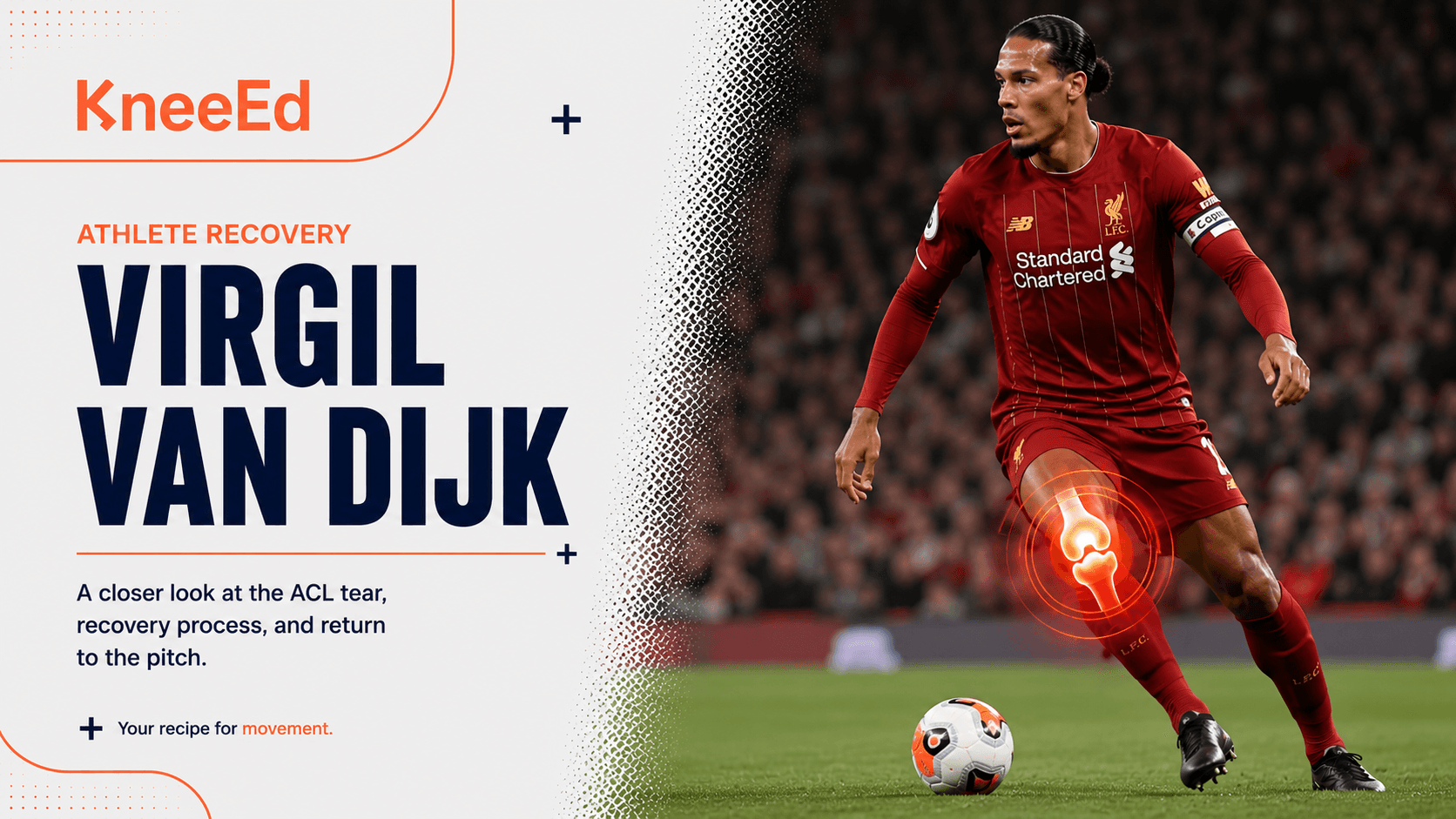
On October 17, 2020, six minutes into the Merseyside derby at Goodison Park, Virgil van Dijk went up for a ball inside the Everton box and came down into a collision he could not avoid. Everton goalkeeper Jordan Pickford slid in low, and his body caught the outside of van Dijk's planted right leg. The knee buckled inward and over-bent under van Dijk's full weight. He limped a few steps, tried to carry on, and could not. He was substituted before the first quarter of the match was over. The diagnosis that followed was the one every footballer dreads: a torn anterior cruciate ligament in the right knee.
He was 29, the best defender in the world by most honest reckonings, the spine of a Liverpool side that had just won the league. An ACL rupture is not a knock you shake off. It is a structural failure of the ligament that keeps the shinbone from sliding forward and twisting under the thigh, and for a centre-back built like van Dijk, 193 centimetres and 91 kilograms, it sits at the intersection of every force a knee is asked to absorb. The standard story would have been a lost season and an open question about whether he would ever be quite the same player again.
He returned to match play 10 months and 18 days after the injury, and within a season and a half he was back in the PFA Premier League Team of the Year, playing at the same elite level he had left.
His comeback usually gets told as a story about a great player being great again. The more useful and more honest version is about the protocol that carried him there, the graft biology it had to respect, the specific demands a tall defender places on a reconstructed knee, and a man who was strikingly candid about the doubt, the pain, and the unexpected gift buried inside the worst injury of his career.
The protocol: one surgery, four places, ten and a half months
The first thing to understand about van Dijk's rehabilitation is how little of it was public, and how deliberately so. He had reconstruction surgery in London. Liverpool confirmed it was successful, and then said almost nothing else. The surgeon was never named in any official capacity, the graft choice was not disclosed, and the clinical detail stayed private, which is standard practice for an elite player whose medical information is a competitive and personal matter. What is documented is the shape of the program, the places it moved through, and the people who ran it: Liverpool's own medical department, not a single celebrity surgeon, owned the rehabilitation from the operating theatre to the pitch.
That distinction matters. The popular image of a star athlete's comeback is built around one famous orthopedic name. Van Dijk's was built around a department and a plan, executed across four distinct settings over roughly ten and a half months. The phases below trace that arc, mapped onto the standard logic that governs any ACL reconstruction.
The four phases, by where they happened
- Immediate post-op in Liverpool (roughly October to November 2020). The earliest and least glamorous work. Calm the joint, control swelling, win back full extension, and switch the quadriceps back on, because the quad shuts down reflexively after this surgery and will not come back on its own. This is the foundation phase that every later gain is built on, and it is the one van Dijk described in the rawest terms, full of pain after the operation.
- The Dubai block at the NAS Sports Complex (roughly December 2020 to February 2021). Around ten weeks of structured loaded rehabilitation in warm weather: yoga and mobility, the exercise bike, progressive strength work, and the first careful, progressive ball work. This was the long middle of the rehab, and the psychologically pivotal stretch, undertaken with his family present through the winter.
- The return to Melwood, Liverpool's training ground (roughly February to July 2021). Back inside the club, the program advanced into multi-planar loading, sport-specific movement patterns, and the harder field work, building toward the demands of a centre-back rather than a rehab patient.
- Pre-season and match return (July to August 2021). A pre-season training camp in Austria, then his first match minutes back in a friendly against Hertha BSC on August 5, 2021, roughly twenty minutes of football, ten months and eighteen days after the injury.
Underneath the geography, the strength and conditioning followed a recognizable elite template. Reporting on the program described a week built around roughly three days of lifting, barbells, dumbbells, and machines, plus a couple of days of core and plyometric work, with eccentric hamstring loading singled out as a priority. That hamstring emphasis is not incidental. For a defender, it is one of the most important decisions in the entire plan, and the science section below explains exactly why.
It is worth mapping his real timeline onto the generic phases clinicians use, because the two line up almost exactly.
- Phase 1 (roughly weeks 0 to 2): range of motion, swelling control, quadriceps activation. Van Dijk's immediate post-op weeks in Liverpool.
- Phase 2 (roughly weeks 3 to 12): loaded strength, blood-flow-restriction work, step-ups, normalizing gait. The early-to-mid Dubai block.
- Phase 3 (roughly weeks 12 to 20): multi-planar loading, sport-specific patterns, plyometrics. Late Dubai into the Melwood return.
- Phase 4 (roughly week 20 onward): sport-specific power and the staged competitive return. Melwood into Austria and the Hertha friendly.
Fullofpainaftertheoperation.Mywifeandmychildrenwerevitalduringthoseweeks.
By May 2021, nine months in, van Dijk was telling Liverpool's own channels that he was on course to be ready for the start of pre-season. He was right. The plan did not chase a dramatic early return. It tracked the standard professional timeline almost to the week and then handed him back to the team on schedule.
The injury: a contact ACL tear, and why a defender's knee is different
To understand the recovery you have to understand exactly what failed, because the nature of the injury shaped how predictable the rehab could be. Van Dijk's was a contact ACL tear, not an overuse breakdown. In the Pickford challenge, the knee was driven through three forces at once under his full body weight: a valgus load that buckled the joint inward, hyperflexion that over-bent it, and internal rotation that twisted the shin under the thigh. The anterior cruciate ligament is the structure that resists exactly two of those, the forward translation of the shinbone and its internal rotation. Loaded in all three directions simultaneously, with no escape route for the energy, it ruptured.
There is a counterintuitive point hiding here. ACL tears are most associated with cutting-sport athletes, the wingers and basketball guards who plant and change direction explosively. Tall centre-backs actually tear ACLs less often through their own movement, because they plant less and cut less violently than the players they mark. Van Dijk's injury did not come from a movement pattern wearing the ligament down. It came from a traumatic, external contact event in a single instant. That origin is part of why the outlook was as good as it was.
Why an isolated tear is the better version of bad news
The single most important clinical fact about van Dijk's knee, after the diagnosis itself, is what was not injured. This was an isolated ACL tear, without the associated damage to the medial collateral ligament, the menisci, or the joint capsule that so often travels with it. That combination matters enormously. When an ACL tear arrives alone, the rest of the knee's architecture stays intact to support the rebuild, and recovery is faster and far more predictable. When it arrives with meniscal or ligament damage, every one of those structures adds its own healing clock and its own constraint. Van Dijk drew the better hand within a bad situation, and the clean, on-schedule timeline reflects it.
The tall defender's loading problem
Here is where height and mass re-enter the story, not at the moment of injury but throughout the recovery. At 193 centimetres and 91 kilograms, van Dijk is a large athlete, and large athletes generate larger ground reaction forces every time they land, decelerate, or change direction. A reconstructed graft in a taller, heavier player has to tolerate bigger loads than the same graft in a smaller one. That is a genuine headwind, and it is honest to name it.
But it is only half the equation. The other half is that pre-injury conditioning is the strongest predictor of how fast and how completely an ACL recovery goes, and van Dijk arrived at the injury as one of the most conditioned defenders on the planet. The larger forces were real. So was the elite baseline built to handle them. The two roughly offset, which is a large part of why a man his size returned on the standard professional timeline rather than behind it.
The injury, stated plainly. A clean, isolated, contact tear in a large but elite athlete, which is the most predictable version of a serious knee injury.
1
Ligament torn. An isolated ACL rupture, with no associated MCL, meniscal, or capsular injury, which is the faster and more predictable pattern.
3
Forces in one instant: valgus load, hyperflexion, and internal rotation under full body weight during the Pickford challenge.
193 cm
Height. With 91 kg of mass, larger ground reaction forces load the graft, offset by an elite pre-injury conditioning base.
29
Van Dijk's age at injury. An elite athlete in his prime, the strongest single predictor of recovery speed and completeness.
Graft science: why the new ligament is weakest when the knee feels strong
Reconstructing an ACL does not mean stitching the torn ligament back together. The torn ACL, sitting inside the joint in fluid with a poor blood supply, essentially cannot heal itself into a functional ligament. So a surgeon replaces it, using a tendon graft, taken either from the patient's own body as an autograft or from donor tissue as an allograft, drilled into the bone where the ACL used to anchor and fixed in place through a minimally invasive arthroscopic technique. What goes in is a tendon. What has to become a ligament, months later, is the same tissue remodeled cell by cell. That transformation is the reason timelines exist at all.
The graft does not arrive strong and stay strong. It follows a curve. It is at its biological weakest at around six weeks after surgery, in the depth of the remodeling phase, when the original tendon structure has been broken down but the new ligament structure has not yet formed. It becomes structurally sound enough for sport at roughly sixteen weeks. And full collagen maturation, the slow finishing of the new ligament into something with the strength and organization of the original, runs anywhere from twelve to twenty-four months.
This produces the most counterintuitive fact in all of ACL recovery, and the one that every cautious phase of van Dijk's plan was built around. The knee feels good long before the graft is strong. Somewhere in the months when an athlete is moving well, lifting heavy, and itching to test the joint, the graft is in the middle of being torn down and rebuilt. The leg reports confidence the tissue has not yet earned. Bridging that gap, keeping load on the knee while keeping it within what the immature graft can survive, is the entire art of the middle phases.
The numbers that should clear a knee, not the calendar
Because the knee lies about its readiness, good rehabilitation clears it with measurements rather than dates. The standard return-to-sport battery is built to expose weakness the athlete cannot feel. It leans on a few core targets, expressed as the limb-symmetry index, the strength or performance of the reconstructed leg as a percentage of the healthy one.
- Quadriceps strength at roughly 90 percent of the healthy leg, measured on isokinetic dynamometry rather than by feel.
- Hamstring strength at 105 percent or more, deliberately exceeding the quad, because the hamstring is the knee's most important dynamic protector against the very motion the ACL used to restrain.
- Single-leg hop tests at roughly 90 percent symmetry across a battery: the single hop for distance, the triple hop, and the crossover hop.
- Multi-directional control checked through the Y-Balance Test and an agility T-Test, plus a psychological readiness questionnaire, because confidence is part of the data, not separate from it.
Why eccentric hamstring strength was the priority
Recall that van Dijk's program singled out eccentric hamstring loading, the Nordic-curl family of exercises in which the muscle generates force while lengthening. This is not a generic strength choice. The hamstring decelerates the shinbone and resists its forward translation, the exact job the ACL did before it tore and the exact job a reconstructed graft is least able to do while it matures. A strong, well-trained hamstring takes load off the new ligament during the moments of highest risk: landing, deceleration, and the planting that precedes a change of direction.
There is a further wrinkle that makes this the right call and a slow one. Eccentric strength, and hamstring eccentric strength in particular, is the slowest quality to return after a reconstruction, and it keeps building well past the point of match return, often eighteen to twenty-four months post-operation. It is also the quality most associated with preventing re-injury in defenders. Prioritizing it early, as van Dijk's program did, is a bet on the long arc of the knee's safety, not just on the date of return.
Idon'tthinktherearealotofexamplesofplayerswhohadanACLandcomplexkneeinjurythatgetsbacktotheirbestafterayear.Therearealotofeyespointinginmydirection,wonderingishegoingtobebackinthesameway.
Proprioception and the defender's movement profile
Strength is necessary but not sufficient. A reconstructed knee also has to relearn where it is in space. The ACL is dense with the sensory receptors that feed the brain its sense of joint position, and reconstruction does not restore that wiring; it has to be retrained. That is why the later phases of any serious ACL rehab are full of single-leg balance work, balance on unstable surfaces, and progressively reactive, unanticipated movement: cutting in response to a stimulus rather than on a pre-planned line, because the pitch never tells you in advance which way to go.
The shape of that retraining is position-specific, and a centre-back's is distinct from a winger's. For van Dijk, the emphasis falls on lateral stability, the hip abduction and external-rotation strength that controls the knee from above, and on deceleration from forward runs, the eccentric quad and hamstring control that lets a defender back up to cover space and then stop. A winger's rehab chases explosive cutting and top-end speed. A defender's chases controlled deceleration and the strength to stay balanced while an attacker tries to throw him off it. The protective movement for a centre-back is precisely this: backing up under control, then accelerating forward, rather than pure flat-out speed work.
The Dubai winter: the part of the comeback that was not physical
The most distinctive stretch of van Dijk's recovery was the ten weeks in Dubai, and what makes it distinctive is not the exercise bike or the warm-weather strength work. It is what he said it did for him. He was strikingly candid about the psychology of the injury, and his honesty is clinically valuable precisely because it refuses the two easy scripts: the brave-face denial and the hollow positivity.
He named the doubt directly, the eyes pointing in his direction, the open question about whether he would be the same. He named the pain after the operation, and the role his family played through it. And then, without contradicting any of that, he reframed the whole experience as one of the best times of his life, because of the time it gave him with the people he loved during a period when football, for once, could not take precedence.
Theinjurydidmealotofgood,evenimmediatelyaftertheoperation.Itwasoneofthebesttimesofmylife.Iwaswithmyfamily,whichwassonice.
It would be easy to dismiss that as a celebrity gloss on a hard year. It is more honest to read it as an accurate account of what a serious injury actually disrupts and clarifies. What it disrupts is routine and certainty, the daily rhythm of being a professional and the assumption that the body will do what it is told. What it can clarify, for some people, is what was underneath all that motion the whole time. Van Dijk's version of mental recovery was not bulldozing the fear. It was sitting with it, leaning on his family, and finding a perspective that made the long middle of the rehab survivable.
The fear itself deserves to be taken seriously rather than waved off, because fear of re-injury after an ACL reconstruction is common, rational, and measurable, which is exactly why the standard return-to-sport battery includes a psychological readiness questionnaire alongside the strength and hop tests. A knee can pass every physical test and still not be ready if the athlete does not trust it. Van Dijk's openness about the doubt, paired with his refusal to let it define the year, is a model of how the mental and physical sides of this injury are not separate tracks but the same one.
The return, and the level
Van Dijk's first football back came on August 5, 2021, in a pre-season friendly against Hertha BSC, around twenty minutes alongside Joe Gomez, who was returning from his own knee injury. Manager Jurgen Klopp framed it carefully, calling it an important first step for both of them, which is exactly the right register for a staged re-introduction to match play. Nobody treated those twenty minutes as the finish line. They treated them as the start of the last phase.
Oct 17, 2020
The injury
Six minutes into the Merseyside derby at Goodison Park. A low Pickford challenge folds the planted right knee inward and over-bends it. The ACL ruptures.
Oct 2020
Surgery in London
Reconstruction in London, confirmed successful by Liverpool. Surgeon unnamed, graft and clinical detail kept private. Liverpool's medical department takes over the rehabilitation.
Dec 2020 to Feb 2021
The Dubai block
Roughly ten weeks at the NAS Sports Complex: yoga, the bike, loaded strength, the first ball work, and the family winter that he later called one of the best times of his life.
Feb to Jul 2021
Back at Melwood
Inside the club again. Multi-planar loading, sport-specific patterns, plyometrics, and the field work that rebuilds a defender rather than a patient. By May he is on course for pre-season.
Jul to Aug 2021
Austria, then Hertha
A pre-season camp in Austria, then about twenty minutes against Hertha BSC on August 5, 2021. Ten months and eighteen days after the injury.
2021 to 2022
Back at the level
Within a season and a half, the PFA Premier League Team of the Year. Not just back on the pitch, but back at the standard he left.
The number that actually distinguishes his comeback is not the return date. It is the level he returned to. Plenty of professionals return to play after an ACL reconstruction. Returning to pre-injury performance is slower, less certain, and the thing his own quote worried about out loud. Van Dijk did it: by the 2021-22 season he was selected for the PFA Premier League Team of the Year, the league's defenders ranked among the best in the world, on a right knee that had been rebuilt the winter before. And in the years since, through June 2026, there has been no documented re-injury to that knee, which is the quiet validating outcome that the doubt was waiting on.
Honest expectations: the timeline is the norm, the level is the outlier
Here is the correction that most retellings of this comeback get wrong. Van Dijk's ten-months-and-eighteen-days return is not remarkably fast. It sits right on the elite athlete curve, where nine to twelve months is the standard window for a professional footballer after an ACL reconstruction. The plan did not beat the clock. It tracked it. Treating his timeline as a target to chase misreads what happened and, on a healing knee, can be dangerous.
The genuinely exceptional part was returning to elite level within roughly eighteen months, the Team-of-the-Year level, not the date of the first match minutes. That is the rarer outcome, and it rested on a stack of advantages most people do not have all at once: a clean isolated tear, an elite pre-injury conditioning base, a full-time professional medical and strength department, a clean run with no re-injury, and the resources to rehabilitate in optimal conditions for as long as it took.
For a non-elite athlete, the honest numbers run longer and slower. A confident return to sport realistically takes twelve to eighteen months, not ten, with proprioceptive and eccentric-strength work continuing well into the second year. The reason for the longer window is the graft biology that does not care about your job title: structural soundness for sport around four months, full collagen maturation out to two years, and an eccentric-hamstring quality that keeps building past the point most people feel finished. The calendar is not bureaucracy. It is the graft's biology made into a date.
The honest baseline for a general reader, not the highlight reel. These are the numbers to anchor expectations to.
9-12
Typical months to match return for an elite footballer after ACL reconstruction. Van Dijk's 10 months 18 days is on the curve, not ahead of it.
16 wk
Roughly when a graft becomes structurally sound enough for sport. It is at its weakest near six weeks, when the knee already feels fine.
12-24
Months for full collagen maturation of the graft. The new ligament keeps finishing long after the athlete is back playing.
12-18
Realistic months for a non-elite athlete's confident return to sport, with proprioceptive and eccentric work continuing into year two.
What protects the knee in the season after return
Getting back is not the end of the risk. The first season after return is where load has to be managed deliberately, because the graft is still maturing and the body is relearning the demands of competition. The protective practices are unglamorous and consistent. Eccentric hamstring strength is the foundation, the Nordic-curl work that decelerates the shin and resists the forward translation the ACL used to prevent. Sport-specific proprioceptive training, single-leg balance on unstable surfaces and reactive cutting drills, lowers re-injury risk by retraining control under unpredictability. And load management matters: gradually increasing high-speed efforts rather than throwing the knee straight back into full-volume football, which is exactly the kind of staged re-introduction Klopp signalled with that first twenty-minute appearance.
For a defender specifically, the smartest protective training mirrors the position. Controlled deceleration, backing up to cover space and then accelerating forward, loads the knee in the patterns it will actually face, and does so more safely than pure top-speed sprinting. Van Dijk's clean record in the years since return is not proof that the danger was imaginary. It is evidence that the slow, eccentric-strength-first, proprioception-heavy version of the work, done patiently and continued past the point it felt necessary, is what keeps a reconstructed knee safe.
What to take from this, if you are the one rehabbing a knee
The right way to admire van Dijk's comeback is to copy the parts that transfer and ignore the parts that do not. What transfers: the patience to win full extension and quad control before anything else, the phased order that puts strength before plyometrics and plyometrics before sport-specific power, the deliberate priority on eccentric hamstring strength, the willingness to be cleared by measured strength and hop symmetry rather than by how the leg feels, and the honesty about the mental side. What does not transfer: the ten-and-a-half-month clock as a target, the full-time resources, and the assumption that an elite outcome is the default outcome. It is not. It is the result of a clean injury, a deep baseline, and a system, aligned at once.
Van Dijk's own framing is the honest coaching takeaway. He did not pretend the injury was easy, and he did not pretend his recovery was magic. He named the pain, named the doubt, leaned on the people around him, did the unglamorous work in the right order, and trusted a system to hand him back to the game on the schedule the biology allowed. The bar he cleared was not the calendar. It was the harder, quieter one: coming back not just present, but as good as he was. That is the comeback worth admiring, and the one worth copying.
References
- 01CBS Sports · Virgil van Dijk to undergo surgery after tearing ligaments on Pickford challenge · Accessed June 2026
- 02Sky Sports · Virgil van Dijk undergoes successful knee surgery in London · Accessed June 2026
- 03Team-ACL · Virgil van Dijk ACL injury and recovery breakdown · Accessed June 2026
- 04Simon Moyes (sports medicine) · Virgil van Dijk ACL injury: a surgeon's analysis · Accessed June 2026
- 05Liverpool FC · Virgil van Dijk exclusive interview: injury, recovery and pre-season comeback · Accessed June 2026
- 06Liverpool.com · Virgil van Dijk injury admission and recovery reflection · Accessed June 2026
- 07Liverpool FC · Virgil van Dijk exclusive: I'm on course to be ready for the start of pre-season · Accessed June 2026
- 08This Is Anfield · Virgil van Dijk takes next step in recovery in Dubai · Accessed June 2026
- 09Liverpool FC · Van Dijk and Gomez: Jurgen Klopp on the Hertha BSC fitness step · Accessed June 2026
- 10This Is Anfield · Explaining Virgil van Dijk's ACL knee injury, return timeline and career implications · Accessed June 2026
- 11Sky Sports · Virgil van Dijk: happy with recovery from knee injury but says there is room for improvement · Accessed June 2026
- 12Wikipedia · Virgil van Dijk · Accessed June 2026