
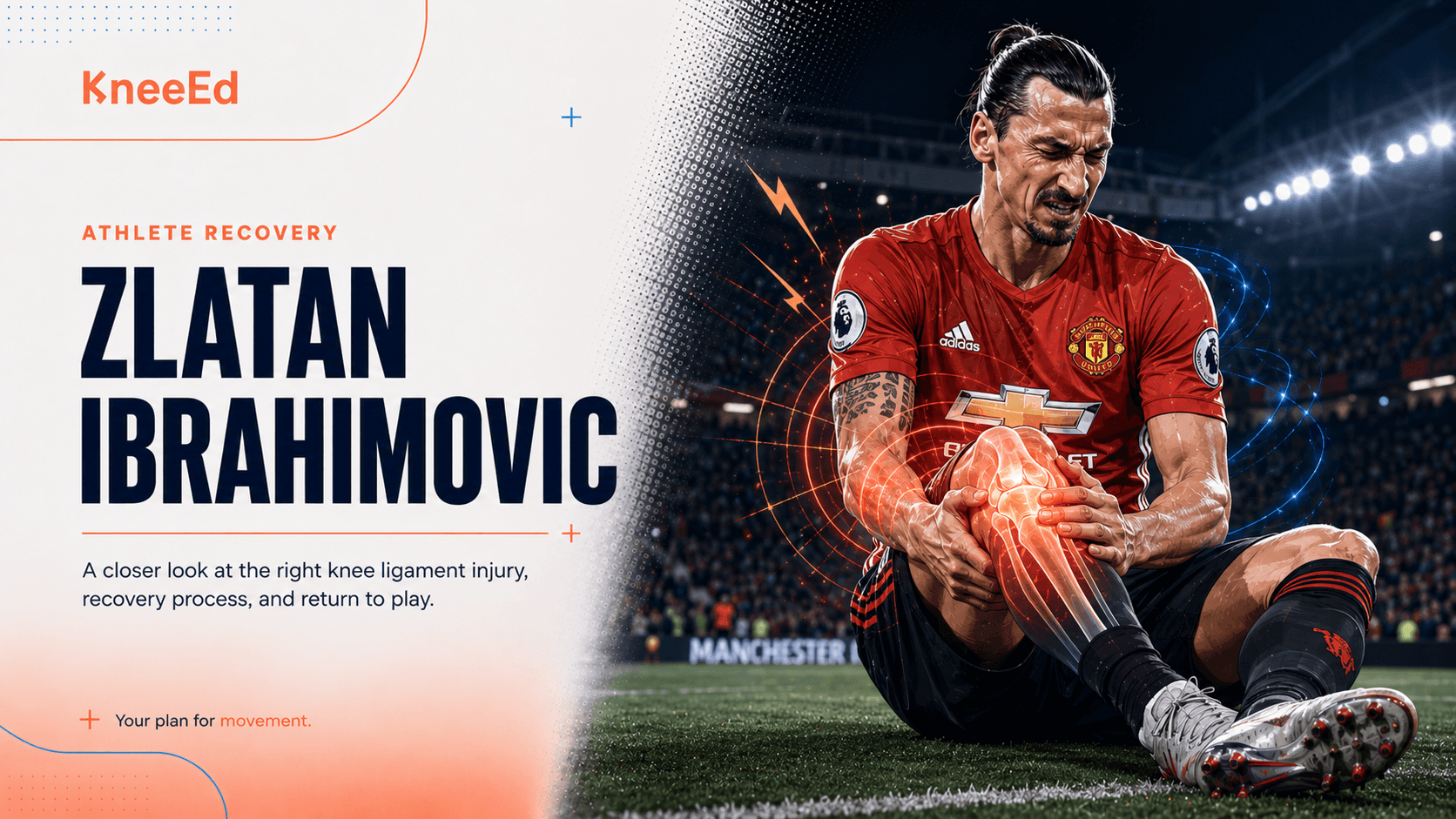
Zlatan Ibrahimovic earned his taekwondo black belt at seventeen, before he was famous for anything he did with a ball. It is the detail that explains the rest of him: the spinning volleys, the absurd flexibility, the certainty that reads as arrogance until you notice it is mostly accuracy. So when the anterior cruciate ligament in his right knee ruptured at Old Trafford on April 20, 2017, a few months past his thirty-fifth birthday, the football world reached for the obvious verdict. A martial artist reached for a different one, and then he reached for a surgeon.
He was back on a pitch 211 days after surgery, and instead of retiring he scored a 40-yard volley on his next club debut and kept playing for four more years, finally stopping at 41, on his own terms.
The easy story is that he believed his way back. The truer story is that the belief was a discipline he had trained for decades, that it was pointed at a meticulously reconstructed joint, and that what looked like will was mostly adherence. This is the closer look: the operation, the science, the prevention, and the honest line between what transfers from his recovery and what is his alone.
The protocol: what actually happened to the knee
Start with the facts, because the facts are more interesting than the legend. On April 20, 2017, in the final seconds of a Europa League quarter-final against Anderlecht, Ibrahimovic landed awkwardly from a challenge and his right knee gave way. It was a complete ACL rupture. He would later disclose that it was more than that. The repair was not a tidy single-ligament job; there was associated damage the team chose to keep private, the kind of compound involvement that ordinarily lengthens a recovery rather than shortens it.
Twelve days later, on May 2, 2017, he was operated on at UPMC Sports Medicine in Pittsburgh by Dr. Freddie H. Fu and Dr. Volker Musahl. Fu was not an ordinary surgeon. The Hong Kong-born chair of orthopaedic surgery at the University of Pittsburgh had performed more than twenty thousand knee operations and over six thousand ACL procedures across a forty-year career, and he had pioneered the anatomic double-bundle reconstruction technique. He died in September 2021. The knee he rebuilt outlasted the verdict everyone else had written for it.
Why the surgeon and the technique mattered
The ACL is not a single rope. It is two functional bundles, and Fu's signature was treating it that way. A standard single-bundle reconstruction replaces the ligament with one graft positioned to restrain the knee front-to-back. A double-bundle reconstruction restores both the anteromedial bundle, which dominates when the knee is bent, and the posterolateral bundle, which carries the load near full extension and is the primary restraint against the rotational, pivoting forces a footballer lives in. For an athlete whose entire game is planting and turning, restoring rotational control is not a detail. It is the job.
ZlatanisoneofthetopathletesI'veevertouched,he'sinsuperbshape.Hecanstillplayformanyyears.
The rehabilitation, phase by phase
The work that followed is where the real recovery lived, and it ran in stages under UPMC supervision before transitioning to Manchester United's training ground. Ibrahimovic described the intensity in a single line that should be read literally, not as boasting:
Iwasworkingfive,sixhoursaday.WhenithappenedIsaidtoeverybodygivingupwasnotanoption.
- Weeks 0 to 6 (May to June 2017): protection. Restore range of motion, control the swelling, switch the quadriceps back on, normalize the walking pattern. Almost nothing here is glamorous, and almost everything that goes wrong later goes wrong because this phase was rushed.
- Weeks 6 to 12 (June to August 2017): early strengthening. Progressive load on the quad and hamstring, and the first proprioceptive work on stable ground, retraining the knee's sense of where it is in space. He then moved the base of operations to Manchester United.
- Weeks 12 to 24 (August to November 2017): dynamic stability. Sport-specific drills, cutting and agility progressions, and the introduction of plyometrics, where the joint relearns to absorb and return force at speed.
- Month 6 and beyond: return to sport. Cleared only once the objective gates are met, not when the calendar says so.
On November 18, 2017, 211 days after surgery and roughly seven months after the injury, he came on in the 77th minute against Newcastle United in a 4-1 Premier League win. The compound injury he had hidden made that date remarkable even among elite returns. His own framing of it was less about magic than about method.
InmyrecoveryIhavenotrushedanything.PeoplemaybelievethatbecauseIhavebeenoutforsixandahalfmonthsbutIhavebeenfollowingprotocolandmyscheduledaybyday.
The case in numbers. Remarkable, and specific.
35
His age at the ACL rupture, the age most assumed would make the injury final.
211 days
From the May 2, 2017 surgery to his return against Newcastle, just inside the elite mean.
6 hrs
His reported daily rehabilitation load through the recovery, five to six hours.
41
His age at retirement, six years after the knee was supposed to end him.
The science: how an ACL reconstruction actually heals
To understand why his timeline is an outlier, you have to understand what the surgeon hands the body and what the body has to do with it. The ACL provides more than eighty percent of the restraining force against the shin sliding forward on the thigh through the mid-range of knee bend. It is built of parallel type-I collagen fibers, and it works as those two bundles. When it ruptures, a graft replaces it. But a graft is not a finished ligament. It is a scaffold the body has to colonize, remodel, and anchor into bone, and that is a biological clock that does not speed up because you want it to.
The biology underneath the calendar
In the first weeks the graft is at its most vulnerable. Fibroblasts proliferate roughly in weeks two through four. Collagen reorganizes from weeks four through twelve. Cross-linking, the process that gives the new tissue its tensile strength, continues from week twelve onward, and the graft's anchorage into the bone tunnels is a parallel job that takes months. This is why a serious ACL return is measured in months and not weeks, and why no amount of effort moves the floor. Adherence buys you a clean, uninterrupted climb through these phases. It does not buy you a shorter biology.
The four-phase rehabilitation, and the gates between phases
Modern ACL rehab is criteria-based, not time-based. You advance when your knee earns it, measured against the other leg. The shorthand clinicians use is the limb symmetry index, the percentage of the uninjured side your reconstructed side can match.
- Phase 1, protection (0 to 6 weeks): full passive range of motion toward 90 to 100 degrees of bend, effusion controlled, gait normalized, quadriceps strength at least 3 out of 5. Red flags here are a swelling that will not settle, a range that plateaus, or a quad that lags.
- Phase 2, early strengthening (6 to 12 weeks): quad and hamstring strength at least 4 out of 5, and the start of proprioceptive work, single-leg balance held for ten to fifteen seconds on stable ground.
- Phase 3, dynamic stability (12 to 24 weeks): strength at 85 percent or better limb symmetry, single-leg hop tests at 85 percent or better, balance held thirty seconds on an unstable surface, sub-maximal cutting introduced. Methods include progressive plyometrics, lateral agility, eccentric hamstring work, and running progression.
- Phase 4, return to sport (6 months and beyond): strength and hop tests at 90 percent or better limb symmetry, an ACL return-to-sport index of 70 percent or better, and a psychological readiness score that has cleared its threshold.
What helps healing, and what sets it back
The interventions that actually move outcomes are unglamorous and well-documented. Early range of motion and quad activation prevent the stiffness that strands a recovery in its first month. Loading progressed in step with the collagen timeline gives the remodeling tissue a reason to organize. Proprioceptive training on unstable surfaces wakes up the mechanoreceptors and rebuilds the neuromuscular feedback that an injured knee loses. Eccentric hamstring work matters more than people expect, because the hamstring is the ACL's primary dynamic protector during deceleration. Plyometric progression teaches the joint to absorb force fast. Even verbal cueing on knee alignment during drills measurably improves how the movement is relearned.
The setbacks are the mirror image. Training through pain and swelling inflames the graft and delays its incorporation. Cutting and pivoting too early loads the ACL exactly when it is least ready, because the ligament sees its highest forces during planted-foot deceleration. Skipping proprioceptive retraining leaves deficits that persist for two to three years even after strength returns, and those deficits raise re-injury risk by three to four times. Inadequate eccentric hamstring work does the same. And fear, the fear-avoidance that makes an athlete move tentatively, degrades movement quality and proprioceptive engagement in a loop that feeds itself.
The mechanism: how the knee tore, and how to protect it
The way Ibrahimovic's knee went tells you why the injury is serious and how the next one gets prevented. It was a non-contact injury, the most common and in some ways the most ominous kind. In the final seconds against Anderlecht, he decelerated rapidly onto a planted foot to receive a pass. The shin rotated inward as the knee began to bend, the knee caved inward under a valgus load from the way the foot was carrying his weight, and there was a hyperextension component as he came down. That combination of valgus, internal rotation, and deceleration in the first thirty degrees of knee bend places maximum stress on the posterolateral bundle, and a quad contraction at that instant adds a forward shear on the shin that loads the ligament to failure.
Why a non-contact tear at 35 is harder, not easier
Nobody hit the knee. That sounds like good news and is not. A non-contact pivot injury points to a neuromuscular control deficit, and those carry a higher re-injury risk than a clean contact tear, because the thing that failed is partly the body's own movement control. Age compounds it: at 35 the proprioceptive system is less sensitive, the neuromuscular response is slower, and muscle protein synthesis is reduced. Professional football then asks the joint for the worst possible loads, two to three times body weight in deceleration and constant multi-directional cutting. And the undisclosed compound damage extended what should already have been a long recovery. Every one of those factors says this return should have taken longer, not less.
How re-injury is actually reduced
The prevention literature is unusually clear, and it is the same toolkit that builds a good rehab, applied for keeps.
- Neuromuscular training: balance on unstable surfaces, single-leg work on a wobble board, lateral stability drills, and crucially the same work performed in a fatigued state. This is the single largest lever, associated with a 52 to 85 percent reduction in risk.
- Hip and core strengthening: hip abductor work and anti-rotation core stability. Poor core control increases knee valgus two to three times and drives ACL stress, so this adds another 30 to 50 percent reduction on top.
- Eccentric hamstring training: Nordic curls and their relatives. The eccentric phase is deceleration protection, and a deficit greater than 10 to 15 percent raises re-injury risk three to four times.
- Plyometric progression: double-leg to single-leg jumps, lateral hop-and-hold, and cutting drills that rehearse the exact pivoting demand of the sport.
- Fatigue and load monitoring: risk spikes at the end of matches and seasons, so deload weeks and load tracking are protective, not optional.
The taekwondo, taken seriously
Here is where his particular history stops being color and starts being mechanism. Read that prevention list again and notice that a lifetime of martial arts trains almost all of it directly. Taekwondo is proprioceptive control, dynamic balance, and rotational command of the body. Kicking mechanics demand single-leg stability under load. The black belt he earned at seventeen had, over decades, built the exact neuromuscular qualities the ACL relies on. He did not start his rehab from a normal 35-year-old's baseline. He started from a body that had spent a lifetime rehearsing balance and control, and he kept training the discipline through recovery to feed the proprioceptive side of it.
The honest read: what transfers, and what is his alone
This is the part that matters most, because the wrong lesson from this story is the dangerous one. Ibrahimovic's 211-day return is a statistical outlier, not a template. The mean return-to-play for elite UEFA players is around 216 days, and he beat that by a few days at 35 with a compound injury. That is extraordinary. It is also explained by causes that almost no one reading this shares.
Why he could, and why most cannot
Five things stacked in his favor: the double-bundle technique that restored rotational control better than a standard reconstruction; a twenty-year elite conditioning baseline that likely exceeded most athletes' peak; the taekwondo proprioceptive foundation; the documented five-to-six-hour daily adherence; and the surgical and rehabilitation expertise at UPMC. His age-35 starting point was probably stronger than most athletes' age-25 one. A typical 35-year-old club-level player with the same tear would be looking at twelve to eighteen months, not seven. His secret was not mental toughness. It was that he began from somewhere almost no one else begins.
What the adherence did, and what it did not do
It is worth being precise about the five-to-six-hour days, because this is where belief gets mistaken for biology. That adherence was real and it mattered, but for specific reasons. It let him progress through all four phases without a setback. It carried him past the month-three-to-five plateau where demoralized patients quietly cut their frequency and lose ground. It allowed an aggressive but legitimate graft preconditioning. And it kept his psychological confidence intact through the slow middle months. What it did not do was accelerate the underlying healing. Fibroblast proliferation, collagen cross-linking, and bone ingrowth are time-dependent, not will-dependent. A less adherent patient with the identical surgery and protocol still needs nine to twelve months. The mind enabled the timeline. It did not shorten the biology.
IknowwhenI'mbackit'smyheadplaying,notmyknee.Mykneehastofollow.
Read that line carefully, because it is more honest than the lion-king bravado he is famous for. His psychological readiness to return arrived before his proprioception was fully healed, which it would not be for two to three years. He came back when the testable criteria were met, strength and hop symmetry at 90 percent or better and a return-to-sport index above threshold, not because the knee was perfect. The mental component enabled the decision to return. It did not accelerate the healing that made the decision safe. And his later admission about the hidden severity of the injury is the tell that the whole thing was an outlier and not a method.
Ifpeopleknewtherealinjury,theywouldbeinshockthatIwasevenplaying.ItwasmorethanthekneebutIwillkeepitpersonal,that'swhyIchoosenottotalkofit.
Realistic expectations, by who you actually are
If you are a recreational athlete in your late thirties or forties training at a moderate level, the honest numbers look nothing like his. Return to recreational sport is nine to twelve months at the earliest. Return to your pre-injury performance is eighteen to twenty-four months. Proprioceptive normalization takes two to three years. Re-rupture risk sits around twelve percent within two years, and strength asymmetry may hover at 85 to 90 percent indefinitely without aggressive long-term training. Chronic pain affects ten to fifteen percent, persistent instability five to ten percent, and fear-avoidance can add three to six months on its own. None of this is failure. It is the actual shape of the recovery, and pretending otherwise is how people re-tear.
So what genuinely transfers from Zlatan Ibrahimovic to you is not the seven months and not the swagger, which belongs to him alone. It is the posture the taekwondo gave him thirty years before he needed it: that a diagnosis is information, not a sentence, and that the person most invested in the recovery should be the one doing the boring, criteria-based work on the days motivation is gone. He treated rehabilitation as a sequence to be drilled, not a feeling to be endured. You do not need a black belt to borrow that. You need a knee plan you will actually do, the patience to let the gates open in order, and the refusal to let an age or an assumption set your ceiling. The lion line was theatre. The adherence underneath it was the whole story.
References
- 01Team ACL · Zlatan Ibrahimovic's ACL injury, double-bundle reconstruction and recovery timeline · Accessed June 2026
- 02beIN Sports · Doctors stunned by the quality of Zlatan Ibrahimovic's knee after surgery · Accessed June 2026
- 03FIFA · Zlatan: I played for six months without an ACL · Accessed June 2026
- 04FourFourTwo · How did Zlatan recover from his ACL injury in seven months? · Accessed June 2026
- 05Sky Sports · Manchester United forward Zlatan Ibrahimovic undergoes successful knee surgery · Accessed June 2026
- 06Sports Illustrated · Zlatan Ibrahimovic on the knee injury: 'Giving up is not an option' (2017) · Accessed June 2026
- 07South China Morning Post · Dr Freddie Fu, the Hong Kong surgeon who saved Zlatan Ibrahimovic's career · Accessed June 2026
- 08South China Morning Post · Hong Kong surgeon saves Zlatan Ibrahimovic's career after knee surgery · Accessed June 2026
- 09TEAMtalk · Zlatan reveals his real struggles on long recovery from ACL injury · Accessed June 2026
- 10Sports Illustrated · Zlatan Ibrahimovic scores a 40-yard volley and the winner on his LA Galaxy debut (2018) · Accessed June 2026
- 11Pittsburgh Magazine · Swedish soccer star: a Pittsburgh surgeon saved my career · Accessed June 2026
- 12National Library of Medicine (PMC) · Anatomy and biomechanics of the anterior cruciate ligament and double-bundle reconstruction · Accessed June 2026
- 13National Library of Medicine (PMC) · Criteria-based progression and return-to-sport testing after ACL reconstruction · Accessed June 2026
- 14National Library of Medicine (PMC) · Neuromuscular training and re-injury prevention after ACL reconstruction · Accessed June 2026
- 15The18 · Zlatan Ibrahimovic knee injury, surgery and return · Accessed June 2026