
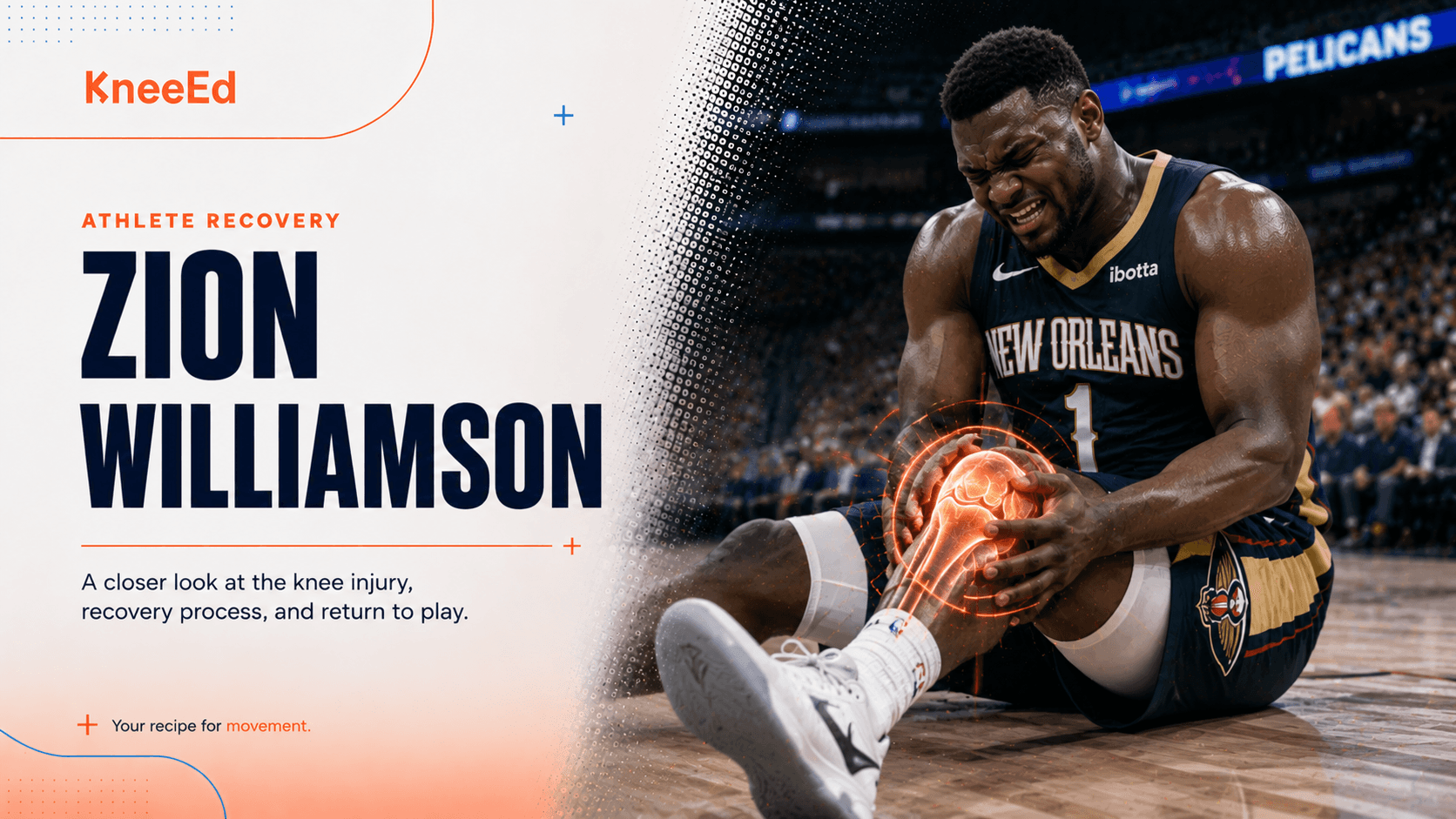
On October 13, 2019, in a meaningless preseason game against the San Antonio Spurs, the most anticipated rookie in a generation scored 22 points and grabbed 10 rebounds, and somewhere in those minutes the lateral meniscus in his right knee tore. Eight days later he was on an operating table. He would not play a real NBA game for another three and a half months.
The easy version of this story is the ending: January 22, 2020, a debut against the same Spurs, 17 straight points in a three-minute fourth-quarter stretch, an arena losing its mind. But the ending is not the interesting part. The interesting part is the decision that made it possible, and it was not a heroic one. It was the decision to be slow on purpose, to let a six-to-eight week timeline stretch to 101 days, and to rebuild the way his knee moved before letting him jump on it again.
He sat 44 games behind a meniscus repair that, by any rushed standard, was structurally healed weeks before he played. His team kept him out anyway, and that is the whole lesson.
The tear
Start with the joint, because everything downstream depends on understanding what was actually damaged. The lateral meniscus is a C-shaped wedge of cartilage on the outer side of the knee, sitting between the thighbone and the shinbone. It is not a passive spacer. It carries roughly 70 percent of the load that passes through the outer compartment of the knee, it deepens the otherwise flat surface of the shin so the rounded end of the femur has something to sit in, and it resists the shearing forces that come when the knee rotates under body weight. When you plant a foot and turn, the meniscus is part of what keeps the joint from sliding apart.
That last function is exactly what gets a meniscus torn in basketball. The classic mechanism is a pivot-shift: a sudden change of direction, a hard deceleration on a planted foot, a rotation of the shin under a flexed and loaded knee. Add knee valgus, the inward collapse of the knee that happens when the hip is not strong enough to hold the thigh in line, and the shear forces on the cartilage spike. A landing on an extended, stiff leg can deliver something on the order of seven times body weight through the joint, where a soft, flexed-knee landing absorbs closer to three. For a 285-pound athlete who jumps and stops like a guard, those numbers are not abstract.
The conditions around the injury
The precise instant of Williamson's tear during the Spurs game was never documented frame by frame, but the conditions around it were not a mystery. He had arrived at training camp, in the words of Pelicans GM David Griffin, noticeably less defined, with cardiovascular conditioning that was not where it needed to be. Then came a steep ramp: months of reduced fitness, into summer league, into a preseason camp, into preseason games. That kind of rapid escalation is precisely the acute-to-chronic workload spike that the research links to a sharp rise in soft-tissue injury risk. A body that has not been progressively loaded, then asked to perform at full intensity with a reckless, high-force style of jump stops and hard pivots, is a body with the dials turned toward exactly this injury.
None of that is a character indictment. It is a description of risk factors, and it matters because the recovery that followed was built specifically to correct them. The Pelicans did not treat the tear as bad luck to be patched. They treated it as the visible failure of a system, and they rebuilt the system.
Repair, not removal
On October 21, 2019, Dr. Jason Folk of the Steadman Hawkins Clinic of the Carolinas and Dr. Misty Suri, the Pelicans' team orthopedic surgeon, performed an arthroscopic procedure on the knee. The detail that matters most in the operative note is the word repair. They repaired the meniscus via debridement rather than removing the torn tissue. For a knee that has to last a 15-year career, that single choice shaped everything that came after, including the length of the recovery.
Why removal is the faster, worse option
There are two broad surgical paths for a torn meniscus, and they sit at opposite ends of a trade-off between speed and longevity. A partial meniscectomy trims away the damaged tissue. It is fast: return to sport can come in roughly four to six weeks, because there is no repair site that has to heal. But you do not get the tissue back. Removing part of the lateral meniscus, the structure carrying 70 percent of that compartment's load, concentrates force onto a smaller area of articular cartilage. The long-term costs are real and well documented: a higher risk of chondrolysis, the breakdown of joint cartilage, and an elevated lifetime risk of osteoarthritis. For an elite athlete in his teens, meniscectomy can buy a fast return and mortgage the knee.
A repair stitches or debrides the tissue so it can heal in place, preserving the joint surface and the load distribution. The price is time. The meniscus has a poor blood supply, especially toward its inner edge, so a repair has to heal biologically before it can be trusted under cutting loads. That is why repair timelines run months, not weeks, and why the choice to repair is, in effect, a choice to be patient. In an elite athlete with good healing capacity and a knee that needs to survive a long career, it is the right trade.
The trade-off the surgical choice locked in. Speed on one side, the longevity of the joint on the other.
~70%
Of the outer-compartment load the lateral meniscus carries. Removing it concentrates force onto cartilage and raises long-term osteoarthritis risk.
4-6 wk
Typical return after a meniscectomy (removal). Faster, but it sacrifices tissue you do not get back.
4-6 mo
Typical return to cutting and pivoting after a meniscus repair in an elite athlete. Slower by design, because the tissue has to heal.
70-80%
Reported success of meniscus repair at five-plus years, materially better than the durability profile of removal.
This reframes the public confusion at the time. When the Pelicans announced a six-to-eight week timeline and Williamson then missed far more than that, it read to many fans as a setback or an overabundance of caution about a phenom. It was neither. The six-to-eight week figure was the window for minimum structural healing of the repair, not the window for returning to NBA cutting and jumping. Those are two completely different milestones, and the gap between them is where the real recovery lives.
The protocol: rebuilding how the knee moves
The most important sentence anyone said during the entire recovery came from David Griffin, and it was not about the meniscus at all. It was about torque.
Howdoyoucontinuetogivehimenoughstrengthtocontrolthetorquehegenerateswithoutaddingweightthatincreasesthetorque?It'sgottobequalitymovement.Themechanicshavetobedoneright.
That is the entire philosophy in two sentences. A heavier, more powerful athlete generates more rotational force through the knee on every jump and cut. You cannot simply tell him to lose weight and call the knee safe, because the goal is not a smaller athlete, it is a knee that can control the forces this particular body produces. So the Pelicans, with new Vice President of Player Care Aaron Nelson leading the rehab and 26 years of NBA training experience behind him, built a recovery centered on movement quality and biomechanical retraining rather than on the scale. They were not just healing a meniscus. They were re-teaching a knee how to absorb load.
Phase one: protect the repair (roughly October 21 to November 30)
The first phase is the one with the least room for improvisation, because it is governed entirely by biology. A fresh meniscus repair cannot be loaded the way an intact knee can, and the early weeks are about protecting the repair site while keeping the rest of the leg from shutting down. Across the field of meniscus-repair rehabilitation, the early protocol looks remarkably consistent, and Williamson's tracked it closely.
- Weeks 0 to 2: a brace holding the knee near full extension, touch-down or non-weight-bearing on crutches, and gentle range of motion only. Isometric quad work begins immediately, quad sets and straight-leg raises, not to build strength yet but to keep the muscle from switching off, which it does fast after knee surgery.
- Weeks 2 to 4: progressive partial weight-bearing as pain allows, with flexion deliberately capped around 90 degrees so the healing tissue is not stressed at deep bend.
- Weeks 4 to 6: the full-weight-bearing protocol begins, the brace and crutches phase out, and light activity starts. By November, Williamson was reporting that the knee felt measurably stronger day to day, and the training staff confirmed the daily gains.
IdofeellikeI'mgettingstrongerdaybyday.Thetrainersaretellingmeit'sgettingstrongerandIcanfeelthedifferencedaybyday.
Phase two: relearn the gait (roughly December 3 to January 21)
Here is where the recovery stopped looking like a generic rehab and started looking like the specific answer to Griffin's torque question. On December 3, about 43 days after surgery, Williamson began on-court work: light walk-throughs, spot shooting, offensive-set walk-throughs. Nothing explosive. The point of this phase was not conditioning in the cardio sense. It was teaching the knee to move correctly under load before it was ever asked to do so at game speed.
Aaron Nelson's framework attacked the exact deficits that produce a lateral meniscus tear. The work was unglamorous and specific:
- Hip abductor and external-rotator strengthening, because a weak hip is what lets the knee collapse inward into valgus during a jump or a cut. Strengthen the hip and the knee stops caving.
- Ankle dorsiflexion mobility, because a stiff ankle forces the knee to rotate inward to compensate. Free the ankle and you remove a hidden driver of knee strain.
- Landing mechanics retraining: moving from knee-dominant landings, where the joint absorbs the shock, to hip-dominant, flexed-knee landings that spread the force through the whole chain.
- Eccentric strengthening for braking, building the muscles' capacity to decelerate, since deceleration on a planted foot is one of the moments the meniscus is most exposed.
- External cueing with resistance bands, force-plate analysis, and film review in which Williamson watched his own movement and corrected it. Trainers tracked step distance, foot positioning, ankle angles, and knee alignment on landing, frame by frame.
This is the difference between rest and rehabilitation. Resting a knee waits for tissue to heal. Rehabilitating one rebuilds the mechanics that broke it. By re-teaching gait, reducing valgus, optimizing footstrike and cadence, and training the hip and ankle to do their jobs, the staff was not just returning Williamson to baseline. They were trying to return him to a knee that moved better than the one that tore.
The criteria, not the calendar
Coach Alvin Gentry said the team would be, in his word, overly cautious, and that Williamson would have to hit specific conditioning metrics and benchmarks before he was cleared. A December 25 return against Denver was floated and then pushed back. This is the part of elite rehab that translates most cleanly to anyone recovering a knee: the decision to play was tied to criteria, not to a date on a calendar.
The criteria for returning to a cutting sport after a meniscus repair are well established. They are not about whether the surgical site has healed, which happens earlier, but about whether the leg can be trusted under sport loads. The standard battery looks for a limb symmetry index of roughly 85 to 90 percent or better, meaning the surgical leg produces nearly as much force as the healthy one, measured on isokinetic strength testing and single-leg hop tests. It looks for clean change-of-direction mechanics, tolerance to deceleration and downhill loading, no swelling after work, and no loss of control in single-leg stance.
Williamson himself understood the logic of waiting better than the people demanding he hurry.
It'salongseason.Thisisn'tlikecollegeorsomethingwhereit's30games.It's82games,soIdon'treallyseeaneedtorushback.
WhenthetrainingstafffeelslikeI'mbacktomyself,they'llletmeplay.It'sassimpleasthat.
Oct 13, 2019 · vs San Antonio
The tear, in a preseason game.
Williamson scores 22 and grabs 10 in a preseason game against the Spurs. Somewhere in it, the right lateral meniscus tears. He had averaged 23.3 points and shot 71.4 percent across four preseason games, the highest preseason scoring by a rookie since David Robinson in 1989-90.
Oct 21, 2019 · Surgery
Repair via debridement.
Dr. Jason Folk and Dr. Misty Suri perform an arthroscopic meniscus repair via debridement. The Pelicans announce a 6-8 week timeline, which the public reads as a return date and which was really the window for structural healing.
Nov 2019 · Phase one
Stronger day by day.
Protected weight-bearing, isometric quad work, capped range of motion. Griffin states he is progressing exactly as hoped. The knee, by Williamson's account and the staff's, gains strength daily.
Dec 3, 2019 · Phase two
Back on the court, slowly.
About 43 days post-op, light walk-throughs and spot shooting begin. The biomechanical retraining starts: hip strength, ankle mobility, landing mechanics, gait analysis on film and force plates.
Jan 22, 2020 · The debut
17 straight points.
101 days after surgery, having met the conditioning and movement criteria, he debuts against San Antonio: 22 points, 7 rebounds, 8-for-11 shooting, with a 17-point fourth-quarter stretch in just over three minutes.
So the clearance came on January 22, 2020, 101 days after surgery, when the movement mechanics were validated and the strength thresholds were met. Williamson had missed 44 games. He posted 22 points on 8-of-11 shooting in 18 minutes, with the famous run of 17 in the fourth. The debut was electric, but read against the protocol it was not a surprise. It was the expected output of a knee that had been allowed to become ready instead of being declared ready.
What the science says back does not mean
It is worth being honest about what a successful meniscus repair does and does not buy, because the comeback narrative tends to round up. A repaired meniscus is not a new meniscus. The procedure preserves far more of the joint than removal does, and that is exactly why it is the better choice, but it does not restore the tissue to its pre-injury state. The knee that returns is a knee that has to be managed, not a knee that has been reset.
Three honest points follow from that, and they apply to any serious knee, not just a famous one.
- Structural healing and return-to-sport readiness are different deadlines. The 6-8 week figure was the first; the real return came at 14-plus weeks. Treating the early structural milestone as a green light to cut and jump is one of the most common ways meniscus recoveries go wrong, alongside ignoring lingering swelling and skipping the proprioceptive retraining.
- The 101-day timeline is an outlier, not a target. It reflects an elite athlete with a full-time medical team, daily access to force plates and film, and a surgical-grade rehab. It is a window into how thorough the process can be, not a clock for anyone else to race.
- The risk factors that caused the tear do not disappear when it heals. Hip weakness, ankle stiffness, a conditioning gap, valgus on landing: if those are not permanently corrected, the re-injury risk, including to the opposite knee, stays elevated. Athletes with a prior meniscus injury carry a higher risk of a meniscus injury on the other side.
This is why the load-management conversation that has followed Williamson is, for the knee specifically, not a knock on toughness. It is the logical continuation of the same protocol. A one-time repair does not grant lifetime immunity. The hip strengthening, the ankle mobility, the gait quality, the progressive conditioning and the periodized rest are not a phase that ends at clearance. For a body that produces this much force, they are the permanent job. Monitoring volume and building in recovery is evidence-based prevention, not weakness, and it is the same logic that kept him out for 44 games rather than rushing him back in six weeks.
What it teaches
The temptation with a story like this is to take the 17 points as the lesson. It is not. The lesson is the 44 games he did not play, and the reasons he did not play them. His team chose a repair over a faster removal because the joint mattered more than the calendar. They let a structural timeline become a movement timeline. They tied the return to strength symmetry and landing mechanics, not to a date. And they spent the most expensive months of the recovery not resting the knee but re-teaching it how to move.
There is a quieter quote from the following offseason that captures where this kind of patience is supposed to lead. After a full conditioning block, Williamson said he had not felt that good since college, since the days when he could walk into a gym and just feel right. That is the actual goal of a recovery done well: not the highlight on the night you come back, but a body that feels like itself again, with a knee built to handle what you ask of it.
ButI'mnotoutforeversomymindsetisjustcomebackstronger,comebackbettersoIcanhelpmyteam.
Come back stronger, come back better. With a meniscus repair, that is not a slogan. It is a description of the only way it works: slowly, on criteria, with the mechanics rebuilt before the speed returns. The waiting was not the obstacle to the comeback. The waiting was the comeback.
References
- 01NBA.com · Zion Williamson to undergo knee surgery, expected to miss 6-8 weeks · Accessed June 2026
- 02Becker's Spine Review · Drs. Jason Folk and Misty Suri operate on Pelicans' Zion Williamson: 4 insights · Accessed June 2026
- 033CB Performance · Zion Williamson's lateral meniscus tear: mechanism and recovery · Accessed June 2026
- 043CB Performance · Zion Williamson and the case for movement retraining · Accessed June 2026
- 05ESPN · Zion Williamson: preparation, preservation, no precedent · Accessed June 2026
- 06NBA.com · Zion Williamson set to make NBA debut Jan. 22 · Accessed June 2026
- 07SLAM · 'I'm not out forever': Zion Williamson upbeat in rehab from knee injury · Accessed June 2026
- 08Bleacher Report · Pelicans' Zion Williamson progressing on schedule in knee injury recovery · Accessed June 2026
- 09NBA.com · Zion Williamson's debut by the numbers and quotes · Accessed June 2026
- 10Stone Clinic · Meniscus repair rehabilitation protocol · Accessed June 2026
- 11NCBI / PMC · Rehabilitation and return to sport after meniscus repair: a review of the evidence · Accessed June 2026
- 12Sports Injury Physio · Lateral meniscus tears: symptoms, treatment, surgery vs exercise, and recovery time · Accessed June 2026
- 13Yahoo Sports · Zion Williamson touts fitness after offseason conditioning program · Accessed June 2026