
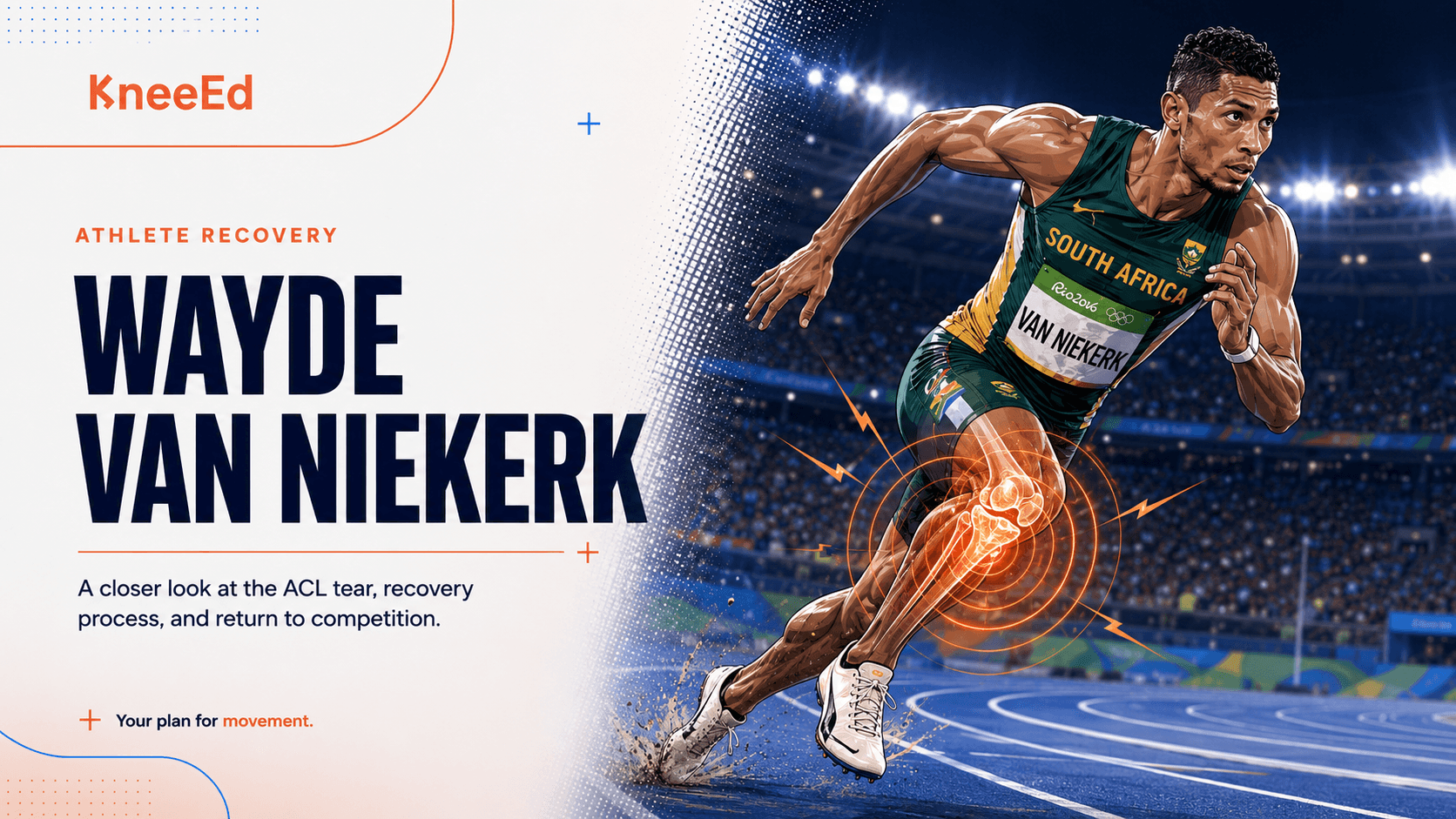
On the night of August 14, 2016, Wayde van Niekerk did something no one had ever done. He won the Olympic 400m final from lane eight, the worst lane on the track, where a runner is stranded out front with no one to chase and no one chasing, blind to the entire field. He could not see Kirani James or LaShawn Merritt behind him. He just ran, and when he crossed the line the clock said 43.03. It was a world record by a fifth of a second, a barrier the great Michael Johnson had held for seventeen years, and it was run without the benefit of a single rival in his eyeline. He was twenty-four.
Fourteen months later, on October 7, 2017, he stepped onto the grass at Newlands Stadium in Cape Town for a celebrity touch-rugby match. There was no clock, no rival, no medal. There was a sidestep, a planted foot, and a knee that folded the wrong way. By the time he was helped off, the fastest quarter-miler in history had torn his anterior cruciate ligament and both menisci, and the rest of his career became a different kind of race entirely.
He had the best surgeon, the best rehab hospital, a coach who had guided him for nine years, money, and motivation. He came back to compete. What he never got back was the form, and that gap is the most useful thing his recovery has to teach.
The seven seconds that cost two years
The mechanism was the most ordinary thing in the world, which is exactly why it is worth studying. Van Niekerk described it plainly afterward: a player tried to sidestep him, stopped, and sat down. In the language of sports medicine, that is a rapid deceleration with the foot fixed to the ground and the body changing direction over it. The shin rotates internally against the thigh, the knee flexes and rolls inward into valgus, and the ACL, the small cord of tissue that stops the shin from sliding forward and twisting out from under the femur, takes a load it was never built to absorb. It is the classic non-contact ACL tear, the same movement that ends seasons in soccer, basketball, and netball every week. No one hit him. The injury came from inside the joint.
What made it severe rather than merely unlucky was the company the ACL tear kept. He also tore both menisci, the two crescents of cartilage that sit between shin and thigh and act as the knee's shock absorbers and load distributors. A lone ACL tear is a well-trodden path. An ACL with both menisci involved is a combined injury, and the meniscus is the part that complicates everything downstream: it changes how soon you can put weight through the leg, it lengthens the timeline, and it raises the long-term stakes, because a meniscus that does not heal cleanly is a meniscus that lets cartilage wear faster for the rest of your life.
For a 400m runner, the location of the damage could hardly be worse. The quarter-mile is not a gentle event. It demands explosive acceleration out of the blocks, the ability to hold near-maximal velocity around a bend with the body leaning and the knee absorbing eccentric load on every stride, and then a brutal fight against deceleration down the home straight when the legs are flooded with lactate. Every one of those phases asks the knee for stability under high force. The ACL is the primary restraint against exactly the rotational and forward-sliding instability that sprinting at speed produces. Rebuild it imperfectly and the joint can hold up walking, jogging, even training, and still betray you at the one thing the athlete needs most.
Ican'tblameanyoneelseformyinjury.I'mtheonewhomadethedecisiontoplayarugbygame.
He has never hidden from that sentence. The injury was not a freak of the track, not a hamstring that went in the heat of a final. It was a modifiable risk he chose to take, a charity game in the middle of a peak training career, and he has owned it without flinching. That honesty matters here because it is the first true thing in a recovery story that would spend two years refusing to behave the way everyone wanted it to.
The numbers that bracket the injury, before and after.
43.03
His Rio 2016 world record, run from lane eight, the first 400m Olympic final ever won from the outside lane.
3
Structures torn in one charity touch-rugby match at Newlands Stadium: the ACL and both menisci.
2 yrs
From the injury to a genuine competitive return, against an initial six-month surgical estimate.
45.14
His time crashing out of the Tokyo 2020 semifinal, more than two seconds slower than his record.
The rebuild: a world-class team, in three places
If money and expertise could guarantee a full return, van Niekerk's recovery would be a closed case. He had access most injured athletes can only imagine, and he used all of it. The rebuild ran across three countries and three distinct phases, each with its own purpose, and tracing it is the clearest map of what serious ACL-plus-meniscus rehabilitation actually involves.
Phase one: the operating table in Vail
Surgery was not rushed. It was performed in November 2017, roughly three weeks after the injury, a deliberate delay that lets the initial swelling settle and the knee recover some range of motion before reconstruction, which is associated with better outcomes and less post-operative stiffness than operating on an angry, acutely swollen joint. The surgeon was Dr. Robert LaPrade, a complex-knee specialist at The Steadman Clinic in Vail, Colorado, one of the most respected names in the world for exactly this kind of multi-structure injury. The procedure reconstructed the ACL and repaired both the medial and lateral meniscus tears in the same operation.
That combination of words, repair both menisci, is the quiet hinge of the whole timeline. When a surgeon repairs a meniscus rather than trimming it away, the repair has to be protected while it heals, which typically means weeks of restricted weight-bearing on crutches and a deliberate brake on how fast the knee can be loaded. The trade is a real one: a trimmed meniscus lets you progress faster but leaves you with less shock absorption for life; a repaired meniscus preserves the tissue but demands patience. For an athlete whose entire career is built on loading the knee explosively, preserving the meniscus is the right long-term call and the slower short-term road. He spent his immediate post-operative weeks in Colorado, roughly four to six in total, beginning the careful early work before the real grind started.
Phase two: six months at Aspetar
From Colorado the work moved to Doha, Qatar, to Aspetar, the specialist sports-medicine hospital, where van Niekerk spent roughly six months in supervised rehabilitation under sports physician Dr. Louis Holtzhausen. This is the part of an ACL recovery that the public never sees and that decides everything. The surgery is a single day. The rehabilitation is the other seven hundred. At Aspetar the job was the unglamorous architecture of a knee: restoring full range of motion, waking up a quadriceps that shuts down after surgery, rebuilding hamstring and glute strength, and then patiently re-teaching the joint to tolerate load, then dynamic load, then sport-specific load, in an order that cannot be skipped.
It is worth naming what that supervised middle phase deliberately avoids. For the first months after a meniscus repair, the protocol steers hard away from the very movements that sprinting demands: lateral resistance work, ballistic loading, pivoting and cutting. Those are withheld not out of caution for its own sake but because the healing tissue cannot yet take them, and asking too early is how a clean recovery turns into a setback. The medical timeline at this stage still carried an optimistic target. There was talk of resuming racing around mid-2018. The knee had other plans.
Phase three: home, and Tannie Ans Botha
From May 2018 the work came home to South Africa, to Bloemfontein and to the woman who had shaped him from the start: Tannie Ans Botha, his coach of nine years, who was seventy-four at the time of his injury. Botha is one of the most distinctive figures in the sport, a grandmother-aged coach famous for a philosophy that, in an ACL recovery, turns out to be exactly the right one. She listened to the athlete's body and adapted the training to it rather than the other way around. She used a metaphor of a ribbon for athletic performance, every strand of conditioning woven together into one integrated whole, no single thread pulled tight at the expense of the rest.
That posture matters more in rehabilitation than in any other phase of an athletic career, because a knee coming back from a combined injury punishes impatience. A coach who treats the calendar as the boss will push a leg that is not ready. A coach who treats the body as the boss will hold a session back when the joint is telling her to. For a long stretch, Botha's instinct to listen was the right hand on the wheel. The trouble, when it came, was not a failure of that philosophy. It was the knee itself.
Oct 7, 2017 · Cape Town
The knee goes.
A planted foot and a change of direction in a celebrity touch-rugby match at Newlands Stadium tear his ACL and both menisci. The world-record holder is helped off the grass.
Nov 2017 · Vail, Colorado
Rebuilt by Dr. Robert LaPrade.
About three weeks post-injury, the complex-knee specialist at The Steadman Clinic reconstructs the ACL and repairs both menisci in one operation. The meniscus repairs set the slow, protected pace of everything that follows.
Late 2017 to May 2018 · Doha
Six months at Aspetar.
Supervised rehabilitation under Dr. Louis Holtzhausen rebuilds range, strength, and load tolerance. The early target of resuming racing in mid-2018 quietly slips.
May 2018 onward · Bloemfontein
Home to Coach Botha.
The work returns to South Africa and to Tannie Ans Botha, whose listen-to-the-body coaching is well suited to a knee that refuses to be rushed.
Apr 2019 · The setback
A bone bruise in the right knee.
Just as a return felt close, a subchondral bone bruise forces him out of the South African nationals and ends his hopes for the 2019 World Championships in Doha. His medical team says they did all they could, and it was not possible.
Feb 17, 2020 · Bloemfontein
The first race back.
Eighteen months past the injury, he runs a hand-timed 10.20 in a 100m on grass. It is a return to racing, if not to the 400m and not to the form.
Aug 2, 2021 · Tokyo
Out in the semifinal.
The defending Olympic champion and world-record holder crashes out of the 400m semifinal in 45.14, fifth in his heat, more than two seconds off his record.
2024 · Paris
A different event, a familiar wall.
He withdraws from the 400m entirely and runs only the 200m, exiting in the semifinals. The fastest 400m runner in history has not run inside 45 seconds since.
The bone bruise, and what setbacks really are
By early 2019 the comeback had a shape and a target. Then, in April, a bone bruise appeared in his right knee. It does not sound like much next to the words torn ligament, but a bone bruise is a real injury: a cluster of microscopic fractures and bleeding in the bone just beneath the cartilage, the kind of subchondral damage that needs its own weeks of recovery, often four to eight, before the bone can take hard training again. Push through it too early and you simply re-traumatize healing tissue and reset the clock. It cost him the nationals and, with them, the 2019 World Championships on the very track in Doha where he had rehabbed. Dr. Holtzhausen's verdict was sober and worth quoting in spirit: the medical teams did everything they could, and it was simply not possible to make it.
The bone bruise is the part of the story most worth dwelling on, because it is the part that generalizes. A setback like this is not bad luck dropped on top of a recovery. It is frequently a signal from inside the recovery. A knee that develops a fresh bone bruise during a return-to-running build is often a knee that is being loaded slightly faster, or slightly less symmetrically, than it is ready for, the protective confidence and proprioception not yet fully rebuilt. The lesson is not that setbacks mean failure. It is that they are information, and the honest response to one is to listen to what it is saying about readiness rather than to grit your teeth and push the date.
The science of an ACL-plus-meniscus return
Van Niekerk's two years did not wander off the map. They tracked, almost exactly, what the research says a combined ACL and meniscus injury demands of a high-level athlete. Understanding that arc is the part of his story that transfers directly to anyone facing the same surgery, so it is worth walking through the phases as a clinician would stage them.
- Immediate post-op (days zero to two): control the inflammation and bleeding, protect the repair, and begin gentle, pain-limited range of motion. The goal is not strength yet. It is a calm joint and a knee that can straighten and bend without fighting.
- Early phase (weeks one to six): weight-bearing progresses on a leash dictated by the meniscus. With both menisci repaired, expect roughly four to six weeks of restricted or partial weight-bearing on crutches, with the protected strengthening of the quadriceps the central job. The quad shuts down after surgery and reactivating it is the foundation everything else is built on.
- Intermediate phase (weeks six to sixteen): strengthening goes progressive and dynamic, physical therapy typically two to three times a week. Crucially, lateral resistance, pivoting, and ballistic work stay off the table for around six months, because the repaired meniscus is not yet ready for rotational and cutting load.
- Advanced phase (months four to nine): sport-specific training and a graded introduction of plyometrics, controlled landings first, then progressively more demanding jumping and bounding as strength symmetry improves.
- Return-to-sport phase (nine-plus months): full competitive training, gated not by the calendar but by objective criteria, strength symmetry above ninety percent between legs, passing hop tests, and genuine psychological readiness to load the knee without bracing against it.
The timing numbers in that last phase are not soft guidance. They are some of the most important findings in the entire field, and they explain why a six-month target was always a fantasy. For every month an athlete delays return-to-sport beyond nine months, re-injury risk falls by roughly half. Athletes who return before nine months are several times more likely to re-tear the ligament. Professional athletes in high-demand sports typically need eight to nine months even for an isolated ACL, and a combined ACL-plus-meniscus injury can add weeks to months on top of that. Van Niekerk's eighteen-month return to racing, far from being slow, sat squarely within the realistic professional window for the severity of what he had done.
FirsttwomonthspostsurgeryIregrettedeverymomentwishingIcouldturnbacktimeorjustredothedecisionsthatbroughtmetowhereIamnow.ButthiswasmyrealityandIjusthadtoacceptmysituationandfindareasontosmileagain.
Notice what that quote is about. It is not about his quad or his hop-test scores. It is about his head. The psychological dimension of ACL recovery is not a soft add-on to the physical work; it is load-bearing structure. Early post-surgical despair, if it is left unaddressed, can become a self-fulfilling prophecy, dampening the motivation to do the daily rehab and feeding an avoidance of the very loading the knee needs. Elite recoveries build in structured mental support for the same reason they build in strength testing. The mind is not a sideshow to the protocol. On the hard days, it is what gets you to the protocol at all.
How a sprinter keeps the knee that did this
If there is a prevention lesson in van Niekerk's case, the loudest one is the simplest: he named it himself. Playing a charity rugby game in the middle of a peak training career was a modifiable risk, a needless exposure of an irreplaceable knee to the exact cut-and-plant movements his own event had trained his body to perform at speed but not to absorb from a standstill in unfamiliar play. The single highest-value injury-prevention decision an explosive athlete can make is to be deliberate about which off-event activities they expose their joints to.
Beyond that, the building blocks of knee resilience for a sprinter are well established, and they are the same blocks that a good rehabilitation rebuilds after a tear, which is why prevention and recovery are really the same discipline viewed from two sides.
- Eccentric hamstring strength, enough to keep the hamstring-to-quadriceps ratio healthy, so the muscles behind the knee can help restrain the forward slide the ACL otherwise carries alone.
- Proprioceptive and balance training, the joint's sense of where it is in space, which is what lets a knee react and stabilize a fraction of a second before a bad position becomes a torn ligament.
- Plyometric work with deliberate, controlled landing mechanics, teaching the knee to absorb and redirect force without collapsing inward into valgus.
- Dedicated deceleration and change-of-direction drills, because the moment of injury is almost always a stop or a cut, not a straight-line stride.
- Core and hip stability, the upstream control that keeps the knee tracking properly under load, plus a genuine warm-up and the discipline to train agility only on appropriate surfaces.
The honest part: back is not the same as the same
Here is the truth the rest of the story has been circling. Wayde van Niekerk came back. He raced again. He stood on an Olympic start line in Tokyo as the defending champion. And he never again ran anywhere near the athlete he had been. The world record was 43.03. His Tokyo semifinal, the race that ended his title defense, was 45.14, more than two full seconds slower, an eternity at this level. He has not broken forty-five seconds since the injury. At Paris in 2024 he did not even contest the 400m; he dropped to the 200m and went out in the semifinals.
This is not a story of someone who did the recovery wrong. It is the opposite. He had a world-renowned surgeon, an elite international rehab hospital, an experienced and humane coach, psychological context, financial resources, and ferocious competitive motivation. He had every advantage a recovery can have. And he still did not get the form back. That is the single most important and most under-told fact about serious knee injuries, and it deserves to be said without softening.
Return to competition is not the same as return to form. After a combined ACL and meniscus repair, you can very often get back to your sport. Getting back to your peak, especially in an event built on explosive deceleration and rotation, is a far rarer outcome.
Van Niekerk's own expectations tell the story of the gap. As he prepared to return, he spoke with real conviction about producing world-class times and challenging his own record again. That was not delusion. It was the reasonable hope of an athlete who had assembled the best possible team. The outcome simply did not follow the hope. The world-class times never materialized, and the body that had once been the fastest in the world over a lap could no longer find that gear.
TherewasamentalaspectthatIhadn'tconsidered...Ihadanissuewithmyback,andIknownowmymindwasnotcentred,andthatcansetyouback.
Even after the knee itself had healed enough to compete, the recovery kept extracting a tax. There were back issues. There were the COVID disruptions that froze his 2020 comeback just as it was finding momentum. There were repeated reports of incomplete races, of pulling up, the kind of pattern that can reflect lingering proprioceptive anxiety or genuine residual instability, a body that no longer fully trusts the joint to take the load it once took without thought. And there is the long shadow specific to the meniscus: combined tears carry a real long-term risk of accelerated cartilage wear and eventual arthritis, which means the cost of that single sidestep may keep being paid for decades.
I'mnothappywithwhereI'matthemoment.I'mputtingintheworkeveryday.ItwasimpossiblewhenIgotthere,anditfeelsimpossiblerightnow.
That is the voice of a man still showing up, still putting in the work every day, and still confronting a ceiling he cannot break. There is no triumphant final scene here, and the refusal to manufacture one is precisely the point.
What his recovery actually teaches
It would be easy to read this as a sad story, and it would be the wrong reading. The lesson is not that recovery is hopeless. It is that recovery should be undertaken with clear eyes. Van Niekerk did almost everything right, and what he got was a real, durable return to competition without a return to peak performance. For the overwhelming majority of people facing an ACL-plus-meniscus repair, who do not have a Steadman surgeon and six months at Aspetar, the realistic message is to be more conservative still, not less.
The parts of his case that genuinely transfer are concrete. Do not rush the surgery into an angry joint. Protect a repaired meniscus and accept the slower road it demands rather than trading away your cartilage for an early date. Let the criteria, strength symmetry, hop tests, real readiness, gate your return rather than the calendar, because the nine-month threshold is written in re-injury statistics, not in impatience. Treat a setback like his bone bruise as information about readiness, not as an enemy to be willed away. Build the mental work in from the first week, because the head decides whether the protocol gets done. And keep the proprioceptive and strength maintenance going long after you feel recovered, because the knee's trust is the last thing to come back and the first thing to slip.
The hardest and most valuable thing van Niekerk's knee teaches is also the most honest. You can do the work, assemble the best team in the world, own your mistake, and show up every single day, and still not get all the way back. That is not a reason to do less. It is a reason to define the goal honestly from the start, to measure success as a strong, stable, durable knee and a return to a full life rather than as a return to a number you may never reach again, and to refuse to let anyone, including yourself, sell you a timeline the tissue cannot keep.
References
- 01ESPN · Wayde van Niekerk wins 400m in world-record 43.03 from lane 8 at Rio 2016 · Accessed June 2026
- 02Sports Illustrated · Wayde van Niekerk tears ACL in charity rugby match (2017) · Accessed June 2026
- 03FloTrack · Wayde van Niekerk tears ACL in rugby match · Accessed June 2026
- 04Team South Africa · Successful knee op for champion van Niekerk · Accessed June 2026
- 05Becker's Spine Review · Dr. Robert LaPrade performs surgery on sprinter Wayde van Niekerk · Accessed June 2026
- 06Aspetar · Wayde van Niekerk returns to South Africa after completing rehabilitation programme at Aspetar · Accessed June 2026
- 07Dr. Robert LaPrade · Wayde van Niekerk's knee op success, now comes months of rehab · Accessed June 2026
- 08Business Live · Bone bruise condemns sprinter Wayde van Niekerk to sidelines (2019) · Accessed June 2026
- 09IOL · Wayde van Niekerk suffers another injury setback, World Champs participation in doubt · Accessed June 2026
- 10News24 · Wayde has forgiven himself for that rugby game (2020) · Accessed June 2026
- 11Trackalerts · Van Niekerk marks return with 100m and 800m runs (Feb 2020) · Accessed June 2026
- 12ESPN · Defending champion and world-record holder Wayde van Niekerk crashes out of 400m semifinal in Tokyo · Accessed June 2026
- 13Olympics.com · Wayde van Niekerk splits from coach Tannie Ans Botha · Accessed June 2026
- 14Olympics.com · Paris 2024: Wayde van Niekerk's individual medal hopes end as he crashes out of 200m semis · Accessed June 2026
- 15Olympics.com · Ans Botha exclusive: coaching career, the future, and van Niekerk · Accessed June 2026
- 16Thomson Medical · ACL and meniscus surgery recovery timeline · Accessed June 2026
- 17Adam Anz, MD · ACL reconstruction with major meniscus repair · Accessed June 2026