
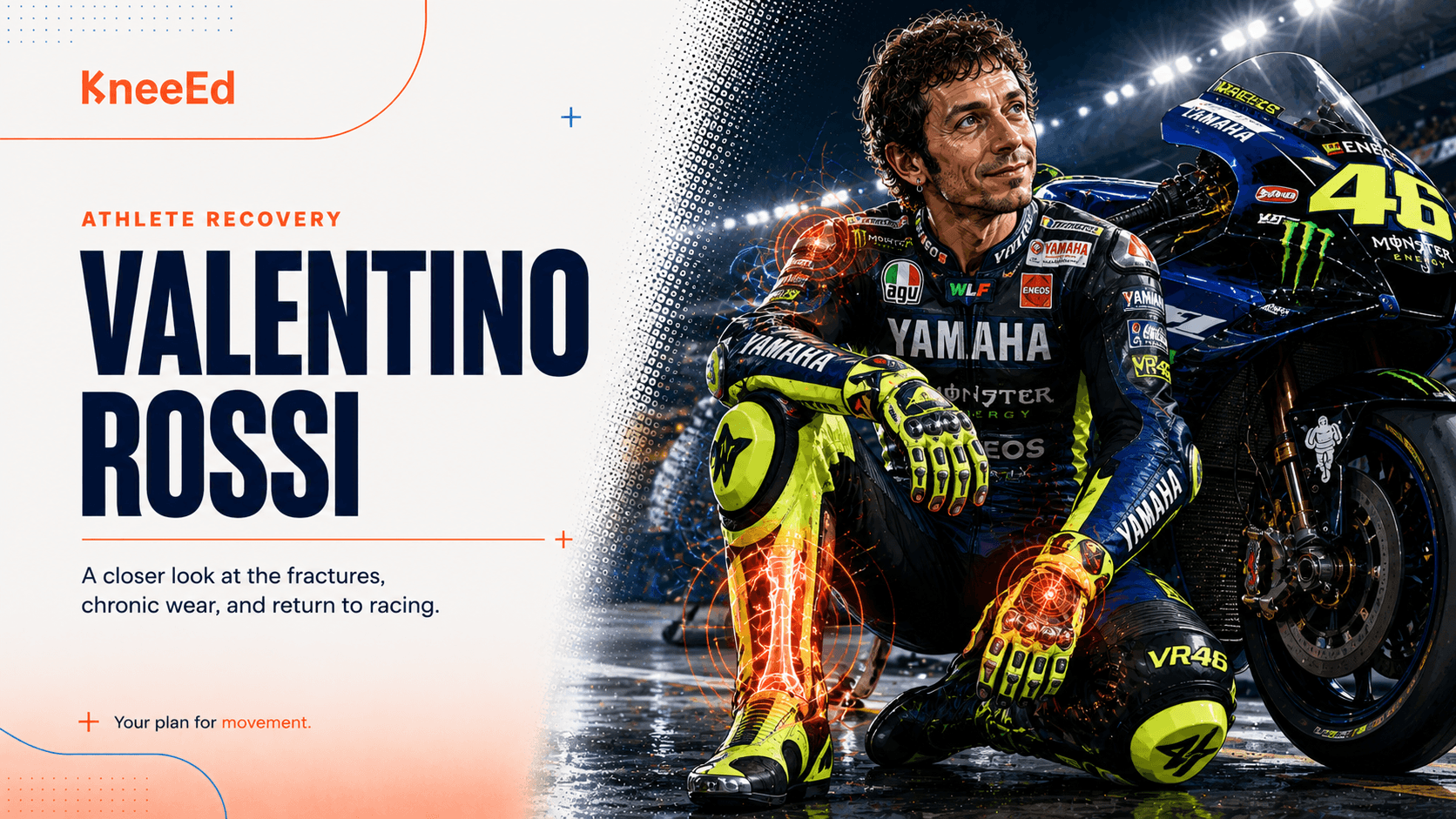
On June 5, 2010, in the second free practice session at Mugello, Valentino Rossi lost the front of his bike at the Biondetti chicane and was thrown to the ground at more than a hundred miles an hour. His right leg took the load. The tibia and fibula, the two bones of the lower leg, both snapped, and at least one bone end pushed through the skin. This is a compound fracture, the kind that turns a broken leg from a clean orthopedic problem into a race against infection. He was the reigning nine-time world champion. He was thirty-one years old. For a moment, on a Friday afternoon, his season was over.
Forty-one days later, with a titanium rod running down the inside of that same bone, he lined up to race a MotoGP bike and finished fourth.
That sentence is the whole story, and it should not be possible. A compound tibia-fibula fracture is, for almost everyone who suffers one, a matter of months on crutches and the better part of a year before high-impact sport. Rossi did it in the time it usually takes the swelling to fully settle. This is not a how-to. It is a case study in what world-class surgery, an early and aggressive rehab, elite physiology, and a calculated acceptance of risk can compress, and in everything that compression cost him over a twenty-six-year career.
The surgery that started the clock
Rossi was taken from the gravel at Mugello and, within hours, was on an operating table at the Centro Traumatologico Ortopedico (CTO) in Florence. The surgeon was Dr. Roberto Buzzi, the head of the trauma unit there, working with assistance from Dr. Claudio Costa of the Clinica Mobile, the traveling MotoGP medical service that has stitched riders back together for decades. The operation ran about two and a half hours under a spinal block rather than general anesthesia.
The order of operations matters with a compound fracture, and it tells you what the surgeons were most afraid of. Before anything structural, the wound was cleaned and irrigated. This is not housekeeping. When a bone breaks the skin, the open environment lets bacteria reach the fracture site, and a colonized fracture can become osteomyelitis, a bone infection that delays healing by months or causes permanent damage. Open fractures are treated as surgical emergencies for exactly this reason, with debridement, irrigation, and antibiotics ideally within hours of the injury. The clock on infection runs faster than the clock on bone.
The rod, the nail, the four screws
With the wound clean, Buzzi stabilized the fracture with an intramedullary nail, locked in place with four screws. The terminology can be confusing because the device is described as both a rod and a nail, but it is one thing: a long titanium implant inserted down the hollow marrow cavity that runs through the center of the tibia. Once it is seated, screws are driven through the bone and through holes in the nail at the top and bottom, locking the whole assembly so the bone cannot rotate or shorten. The tibia is, in effect, splinted from the inside.
Thealignmentwasgoodandtheboneisnowstable.
Buzzi's post-operative summary was understated and exact. The alignment was good, meaning the bone ends were lined up correctly, which is one of the two big determinants of whether a fracture heals or fails to knit. The bone was stable, meaning the nail was doing its job. He also confirmed that the fracture had not compromised circulation or nerve function in the leg, which is the difference between a serious injury and a catastrophic one. And he laid out the early plan with a precision that, in hindsight, set the entire timeline in motion.
WeareconfidentthatValentinowillbeabletoleavethehospitalinaweektotendays,abletoputweightonthelegwiththeaidofcrutches.
A week to ten days in hospital, then roughly six weeks of partial weight-bearing on crutches. That was the textbook plan, the one a careful surgeon describes to a thirty-one-year-old patient the day after surgery. Rossi would not follow it. He would beat it by a margin that still makes orthopedic surgeons wince.
What actually breaks, and how a bone knits back
To understand why forty-one days is extraordinary, you have to understand what the body is actually doing in those days. The tibia is the large bone at the front of the lower leg and the primary weight-bearer; the fibula is the slender bone on the outside, more of a stabilizer and a muscle anchor. When both fail at once, the structural integrity of the lower leg is gone, and at a hundred-plus miles an hour the surrounding muscle, tendon, and soft tissue take damage too. The bones are only the part you can see on an x-ray.
The four phases of fracture healing
Bone does not heal like a cut, by sealing over. It rebuilds itself through four overlapping biological phases, and each one has to happen in order. There is no skipping ahead, only, at best, doing each phase a little faster.
- Inflammatory phase (roughly the first week). A hematoma, a clot of blood, forms at the fracture site and becomes the scaffold for everything that follows. Inflammatory cells arrive and clear debris. This is the phase an open fracture puts at infection risk.
- Soft callus phase (weeks two to three). Fibroblasts and chondroblasts move in and lay down collagen and cartilage, forming a soft bridge across the break. The bone is connected now, but the connection is rubbery, not load-bearing.
- Hard callus phase (weeks three to twelve). The soft cartilage callus is gradually replaced by mineralized, woven bone. This is when the fracture becomes mechanically real, when it can start to carry meaningful load. It is also the phase Rossi was racing through.
- Remodeling phase (months three to twenty-four and beyond). The disorganized woven bone is slowly replaced by strong, organized lamellar bone, and the tibia is sculpted back toward its original architecture. This phase outlasts the athlete's return by a year or more.
The standard numbers attached to that biology are sobering. Initial recovery from a tibia-fibula fracture is typically three to four months. Weight-bearing restrictions usually run four to six weeks. And return to actual sport is measured not in weeks but in something far longer. One frequently cited study of soccer players with tibia-fibula fractures found an average return to sport of around forty weeks. Not forty days. Forty weeks.
The gap between the textbook and what Rossi did, in numbers.
2
Bones broken at once, the tibia and fibula, in a compound fracture that breached the skin.
4
Screws locking the intramedullary nail in place, splinting the tibia from inside the marrow cavity.
40 wk
Average return to sport after a tibia-fibula fracture in published literature on athletes.
41
Days from Rossi's fracture to racing a MotoGP bike at Sachsenring, where he finished fourth.
Why the nail is the gold standard
Intramedullary nailing is the gold-standard fixation for these fractures, and the reasons are exactly the reasons it let Rossi move so early. Because the nail sits inside the bone rather than being plated along the outside, it preserves the surrounding soft tissue and blood supply. Because it is locked with screws, it provides stable fixation that resists rotation and collapse. And because the construct is stable, it permits earlier mobilization than older methods. The nail does not make the bone heal faster. It makes it safe to load the leg while the bone heals, which is a different and crucial thing.
Stability is not the same as healing, though, and this is where the risk lived. The nail held the bone in position, but the four phases still had to run. Loading a tibia that is only in its hard-callus phase, before remodeling has built real strength, is precisely the bet Rossi made. The two classic failure modes after this kind of injury are non-union, where the bone never fully knits, and malunion, where it knits in the wrong position. Both are made more likely by gaps at the fracture site or by loading too hard, too soon. So is re-fracture.
The forty-one days, step by step
What Rossi and his medical team actually did inside those forty-one days is the heart of the case study. The single most-cited factor in how fast he healed was timing: his personal physician began an aggressive rehabilitation within twenty-four hours of surgery, while a more conservative protocol would still have had him resting. Recovery also included sessions in a hyperbaric oxygen chamber, which can raise tissue oxygen levels and, in early phases, support the activity of osteoblasts, the cells that build new bone. The evidence that hyperbaric therapy accelerates a sport-specific return is limited, but as one input among many, in a patient with every other advantage, it was part of the picture.
Jun 5, 2010 · Mugello
The crash and the surgery.
Rossi loses the front at the Biondetti chicane at over 100 mph. A compound fracture of the right tibia and fibula. Dr. Roberto Buzzi operates at CTO Florence the same day, placing an intramedullary nail with four screws.
First days · Florence
Rehab starts within 24 hours.
Against the textbook timeline, aggressive rehabilitation begins almost immediately after surgery, alongside hyperbaric oxygen chamber sessions. Hospital discharge follows in about a week to ten days.
Jul 7, 2010 · Misano
First test, 32 days out.
Rossi rides a superbike at a private test at Misano, thirty-two days after the fracture. He shows discomfort. The leg is not ready, but the leg is moving.
Jul 12, 2010 · Brno
A positive test, 37 days out.
A second superbike test at Brno, thirty-seven days out, goes far better. He completes 46 laps. The question shifts from whether he can ride to whether he should race.
Jul 14, 2010
Cleared to race, 40 days out.
Medical clearance comes through forty days after the injury. The decision is made.
Jul 18, 2010 · Sachsenring
Fourth place, 41 days out.
Rossi races the German Grand Prix forty-one days after a compound fracture of both lower-leg bones and finishes fourth, having missed only four rounds.
Even the people responsible for clearing him struggled to explain it. The reaction inside the paddock was not celebration so much as bafflement, and it came from the medical side, not the fans.
IhavetoadmitIwasperplexedbyhowwellhehasrecoveredfromthistypeofinjury.
Charte's word, perplexed, is the honest one. Several factors stacked in Rossi's favor and none of them are available to most patients. He was thirty-one with high bone quality and elite fitness. He had world-class medical care from the first minute, including helicopter transport, a top trauma surgeon, and access to a hyperbaric chamber. He had a personal physician dedicated to driving rehab from day one. And he had a tolerance for risk, and a financial and competitive incentive to take it, that no ordinary person would or should accept. Subtract any one of those, and forty-one days becomes four months.
The same leg, again, in 2017
The forty-one days was not a one-off, and the second time tells you something the first time hid. On August 31, 2017, training on an enduro bike, Rossi fractured the same right tibia and fibula again. That a leg breaks twice in the same place is rarely pure coincidence. An original fracture site, even a well-healed one, can carry structural vulnerability, scar tissue, and altered loading that make the bone or the area around it more susceptible to a repeat injury. The leg that had carried a titanium nail since 2010 was, in some sense, a marked leg.
The 2017 fracture was deemed less serious than the 2010 one, and Rossi's compressed timeline returned with it. He was passed fit and back racing at Aragon in twenty-one to twenty-two days, where he qualified third and finished fifth. His own framing was characteristically blunt, and it captures the psychology that drives these returns as much as any medicine does.
Ithinkthatit'simportanttocomebackonthebikeassoonaspossibleandnotstayathomeforanotherrace.
There is a logic there, but it is a racer's logic, not a clinician's. Coming back as soon as possible is what the sport rewards and what the rider wants. It is also, repeatedly, the thing that places the most load on the least-ready tissue. Rossi could absorb that bet twice and win it twice. The point of telling it honestly is that the bet does not always pay, and the house edge is on the body.
I,likealltheotherguys,wanttocomebackassoonaspossiblebecauseit'swhatwelikeandwhatwewanttodo.
The chronic toll of twenty-six years
A single fracture, even a dramatic one, is an acute event. It heals or it does not, and Rossi's healed. The harder story is the slow one underneath it: what a quarter-century of high-impact racing does to a body over time, and why the leg that broke was not a fresh leg to begin with. Rossi started Grand Prix racing in 1995 at seventeen and retired in 2021 at forty-two, a career of twenty-six seasons across four classes, nine world titles, and one hundred and fifteen Grand Prix wins. By 2010, that body had already absorbed thousands of impacts, the repetitive high-G loading of cornering at extreme lean angles, and the accumulated micro-trauma of braking zones taken at the edge of physics.
What accumulates when you race for a living
The chronic toll of a high-impact sport is not one injury. It is a slow ledger, and most of it never makes a headline.
- Joint degeneration. Decades of loading wears cartilage and accelerates the kind of arthritic change that, in a normal person, arrives much later in life.
- Cumulative microfractures. Repetitive traumatic loading creates small bone insults that, individually, heal, but collectively change how a bone tolerates the next big load.
- Ligamentous laxity. Repeated stress to the stabilizing ligaments can leave joints looser and less protected over time.
- Muscle atrophy after immobilization. Every period in a cast or on crutches costs muscle that must be deliberately rebuilt, and the rebuilding is never quite complete.
- Structural vulnerability at old injury sites. As the twice-broken right leg shows, a healed fracture is not the same as an untouched one.
MotoGP fractures are especially severe precisely because of the velocity and the forces involved, the lean angles and braking loads that have no equivalent in everyday life. A rider's body is not only injured occasionally; it is, chronically and by design, loaded near its tolerance for years. The 2010 break was spectacular. The wear that surrounded it was the quieter, more universal injury, the one that does not get a surgeon's name attached to it.
When Rossi announced his retirement in August 2021 and rode his final race at Valencia that November, the decision read, to anyone watching closely, as the sum of that ledger as much as any single moment. The accumulated wear, the joint damage, the repeated rebuilds from injury, the psychological cost of twenty-six years at extreme demand. Career longevity in motorcycling is not the absence of this toll. It is the willingness to accept repeated injury, chronic pain, and progressive degeneration as the price of staying. His number 46, chosen to honor his father Graziano's own Grand Prix career, was officially retired by MotoGP at the 2022 Italian Grand Prix, and he entered the sport's Hall of Fame as an official Legend.
What the case actually teaches
It is tempting to take Rossi's forty-one days as proof that a broken leg can be beaten by sheer will and the right doctor. That is the wrong lesson, and a dangerous one. The right lesson is more useful and more honest, and it survives the fact that the timeline was an outlier.
- The surgery sets the ceiling. A clean reduction, good alignment, and stable fixation, the nail and the four screws, are what made early loading even thinkable. The recovery cannot beat the quality of the repair underneath it.
- Infection is the first enemy with an open fracture. The wound cleaning came before the structural work for a reason. With any breach of the skin, the race against bacteria is run before the race against time.
- Stability lets you move; it does not mean you are healed. Rossi could load his leg because the nail held it, while the bone was still in its hard-callus phase. Knowing the difference is the whole safety margin.
- Early, supervised movement matters, within limits. Rehab starting within twenty-four hours, under expert care, is real. Starting it on your own, without that structure, is how you find non-union and re-fracture.
- Elite outcomes are bought, not free. Rossi's speed came from genetics, fitness, world-class care, and accepted risk stacked together. Remove any layer and the timeline lengthens toward the textbook.
Rossi finished fourth at Sachsenring forty-one days after both bones in his lower leg snapped through the skin at a hundred miles an hour. It is one of the most remarkable returns in the history of sport, and the championship he was chasing slipped away regardless, with Jorge Lorenzo taking the 2010 title in his absence. The achievement was never that he came back fast. It was that he came back fast and the leg held, twice, and then carried him for another decade until the slower injury, the wear of the years, finally decided the matter. The forty-one days belong to him alone. The biology behind them belongs to everyone, and it is the part worth keeping.
References
- 01Motorcycle News (MCN) · Mugello MotoGP: Valentino Rossi surgery a success, including Dr. Roberto Buzzi on alignment, stability, and the discharge plan · Accessed June 2026
- 02MotoMatters · Anatomy of a crash: how Valentino Rossi broke his leg at Mugello · Accessed June 2026
- 03Asphalt & Rubber · Displaced fractures and surgery: the details of Valentino Rossi's broken leg · Accessed June 2026
- 04Motorsport.com · MotoGP doctor Angel Charte perplexed by Rossi's recovery speed after 2017 fracture · Accessed June 2026
- 05Autosport · Rossi recovery perplexing, MotoGP doctor · Accessed June 2026
- 06Crash.net · Valentino Rossi injury: it will take 30 to 40 days to recover · Accessed June 2026
- 07CNN · Rossi targets MotoGP return from broken leg · Accessed June 2026
- 08Crash.net · Valentino Rossi: it's what we do (Aragon, 2017) · Accessed June 2026
- 09ESPN · MotoGP legend Valentino Rossi passed fit for Aragon 21 days after breaking leg · Accessed June 2026
- 10PMC / NCBI · Return to sport after tibia-fibula fractures in athletes, including timeline data · Accessed June 2026
- 11OrthoVirginia · Tibia fracture treatment and recovery · Accessed June 2026
- 12NCBI / PMC · Bone fracture healing phases and intramedullary nailing · Accessed June 2026
- 13OrthoInfo (AAOS) · Open fractures: urgent debridement, irrigation, and infection risk · Accessed June 2026
- 14MotoGP.com · Rossi's ninth title win, the statistics · Accessed June 2026
- 15Motorsport.com · Valentino Rossi's famous #46 number retired · Accessed June 2026