
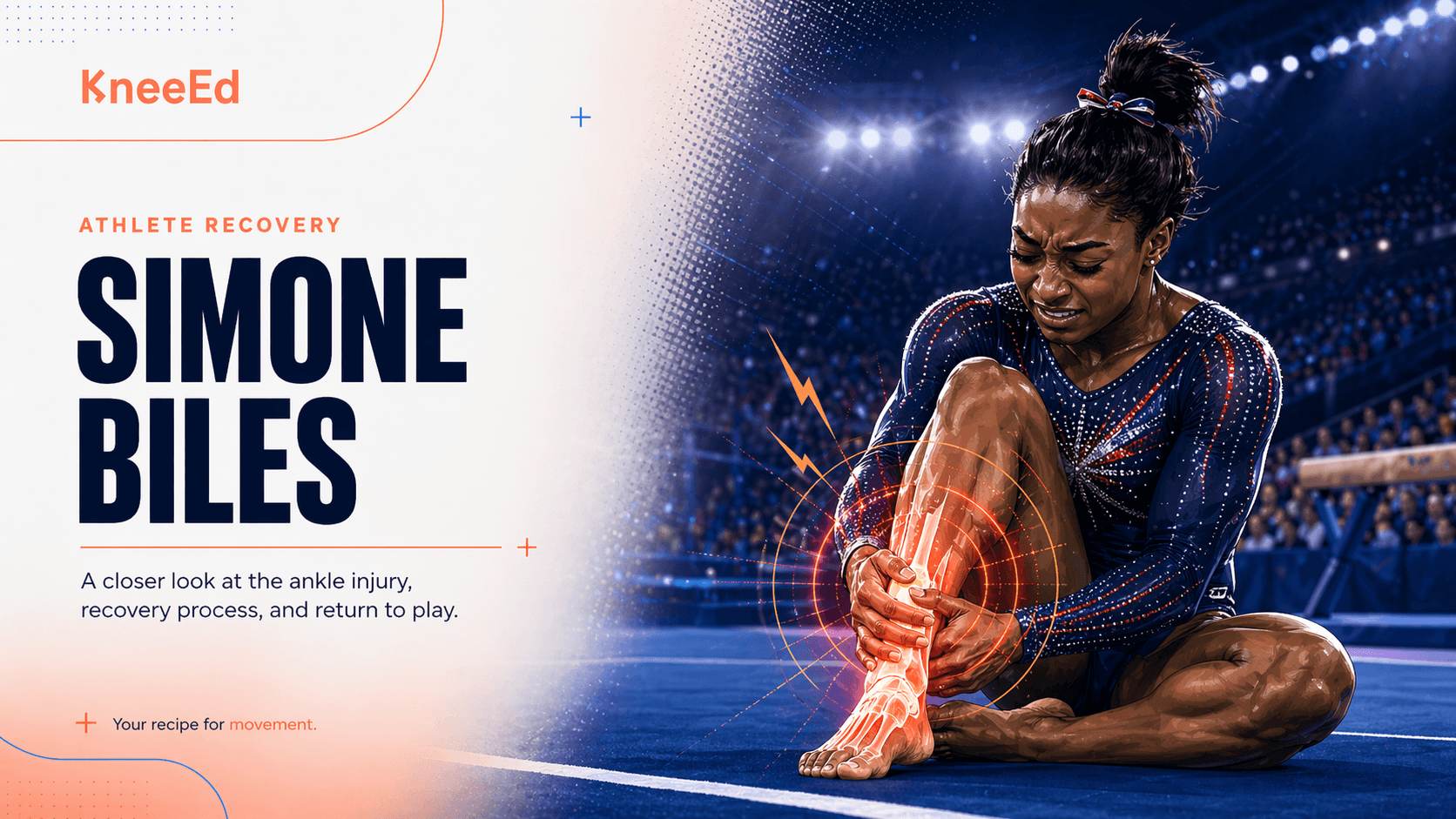
Most calf-strain stories are recovery stories. Someone tears a few fibers, the leg gets rested, the tissue knits, and weeks later the athlete is back. The Simone Biles story from Paris is the rarer kind. She did not recover from the strain and then compete. She competed on it, in real time, with a medical team reading the leg between rotations, and only began recovering once the meet was over and the boot went on.
She felt the calf go in warm-ups, and roughly four minutes later she was on the vault runway anyway.
What happened in those four minutes, and across the four rotations that followed, is the closest most people will come to watching live sports medicine make a high-stakes call. This is what the leg was actually doing, what the team did about it, and where the honest line sits between her situation and yours.
What actually tore
Start with the tissue, because the whole decision rests on it. The calf is two muscles stacked over the same tendon. The gastrocnemius is the bigger, more visible one, and it crosses both the knee and the ankle, which makes it the muscle that handles explosive, springy demands like jumping and vaulting. The soleus sits underneath it, crosses only the ankle, and does the quieter, longer endurance work. Both feed into the Achilles tendon, which is where the landing forces ultimately concentrate.
Biles aggravated her left calf on July 28, during warm-ups for the qualifying round, on floor. She had history in that leg. In the weeks of training before Paris she had hyperextended the same knee and dealt with a prior calf-muscle issue in the same leg, so the tissue was not arriving fresh. Her coach told reporters afterward that she felt a little pain in her calf during warm-ups, that the injury was minor, and that there were no plans to sideline her. The later Netflix documentary, Simone Biles Rising, framed it more bluntly as a strain slash tear, and revealed that in the moment Biles feared something far worse: an Achilles rupture, the catastrophic version of this injury, the one that ends seasons.
Why a calf strain is not a small thing in this sport.
6-8 G
Peak landing force a Yurchenko double pike can put through the lower leg when the landing is rushed.
~2 G
What that same force drops to when the landing is timed well and spread over a longer window.
Grade 1
Mild strain: a few fibers stretched or torn, strength and walking largely preserved, but the tissue is now vulnerable.
Here is the mechanism that makes the calf the muscle on the line. When you land from height, the calf does not just hold; it lengthens under load while contracting, an eccentric action, to decelerate the body. That eccentric brake is the single most demanding thing you can ask of a muscle, and it is exactly where strains happen. A good landing, around three tenths of a second of give, spreads the force out and keeps peak load near two times body weight. A rushed landing, closer to one tenth of a second, concentrates the same energy into a spike of six to eight G straight into the calf and Achilles. On a healthy leg that is survivable thousands of times. On a leg with torn fibers it is the difference between a strain and a rupture.
Grade 1, and why it can be played on
A grade-1 strain is the mildest of the three grades. A small number of fibers are involved, there is localized tenderness and pain, but gross strength is largely intact and the athlete can usually walk and even perform non-maximal movements. That intactness is the whole reason competing is even on the table. A grade-2 strain, with a meaningful portion of the muscle torn, would have taken the decision away. The honest read is not that her injury was minor. It is that it was the one grade where a trained team can build a case for going.
The protocol, before the heroics
The temptation is to make this a story about willpower. It was not. It was a story about a system. The people in that four-minute window each had a defined job, and the decision was distributed across them rather than dumped on the athlete.
- Dr. Marcia Faustin, co-head team physician for the U.S. women's team, owned the medical assessment: confirming what had happened, deciding it was safe enough to clear, and prescribing the taping and bracing approach.
- Cecile Canqueteau-Landi, Biles' personal coach and a 1996 French Olympian, owned the go or no-go calls on each event and the load strategy across the meet.
- Laurent Landi, co-coach, watched technical form and cued execution so a compensating leg did not turn into a bad landing.
- USOPC athletic trainers, the credentialed staff who travel with the team, applied and reapplied the tape and brace and supported the leg between rotations.
ItoldthetrainerswhatIfelt.Theytoldmewhattheysaw.ThenIwenttovault.
That sentence is the whole protocol in miniature. The athlete reports the subjective signal, what it feels like. The clinicians report the objective signal, what they can see and test. The two are reconciled into a decision, and only then does anyone move. It is the same loop a good return-to-play conversation should run, just compressed into minutes under the brightest lights in sport.
What the tape and brace were actually doing
The leg was managed with two layers. Standard athletic tape went on in a figure-eight wrap, which limits how far the ankle can plantarflex and dorsiflex, reining in the end-range motion that loads a torn calf hardest. Over or alongside it sat a soft lace-up ankle brace, which adds lateral stability and, just as importantly, proprioceptive feedback. That second word matters more than it sounds. Tape and a brace do not meaningfully replace the strength of a muscle. What they do is feed the nervous system extra signal about where the joint is in space, which prompts the surrounding stabilizers to fire a beat sooner and lets the brain dial down the protective pain response slightly. The leg feels more trustworthy, and a more trusted leg moves more normally.
There is a catch worth knowing, because it shaped the timing. Athletic tape loses much of its restrictive grip within roughly fifteen to thirty minutes of hard movement. That is a documented clinical limitation, not a guess. It is why the staff applied the tape fifteen to thirty minutes before the calf-heavy events specifically, and almost certainly re-taped between rotations rather than trusting one application to last the whole meet. The support was being topped up, not set and forgotten.
Competing with a calf strain
This is the part that separates the Paris story from an ordinary comeback, and it deserves to be understood as a strategy rather than a stunt. Competing with an active strain is not the same as ignoring it. It is a load-management problem solved live, and the team solved it on four levers.
- Order the events by load, hardest first. Vault, the single most calf-intensive event, went first, while the muscle was fresh and most responsive rather than fatigued and stiff. A tired muscle has worse shock absorption and duller proprioception, so spending the calf's best minutes on its hardest task was deliberate.
- Build in a recovery window mid-meet. Uneven bars, which barely loads the calf, sat second and functioned as a roughly ninety-second microrecovery for the leg in the middle of the competition.
- Hold the line on the medium-load event. Balance beam came third. A beam is ten centimeters wide; there is no tolerance for a slip or a hop, so the tape stayed on and the margins stayed tight.
- Save the second hardest landing for last. Floor, on the hardest landing surface in the meet, came fourth, taped and braced, and she finished it without a hop on the affected leg.
Warm-up - Floor
The calf goes, and a four-minute window opens.
The strain is detected and confirmed. Athlete report and clinician read are reconciled. The decision to compete is made before the first rotation begins.
Rotation 1 - Vault
Highest load, taped, braced, cold muscle by design.
Yurchenko double pike. Stuck landing, a 15.8. The hardest single demand of the meet spent while the leg was at its freshest.
Rotation 2 - Bars
The lowest-load event, used as a recovery window.
Minimal calf demand. Roughly ninety seconds of relative rest for the leg, routine completed cleanly.
Rotation 3 - Beam
Medium load, zero margin for a hop.
Tape maintained, a ten-centimeter surface, no slip tolerance. Routine completed without a stumble on the leg.
Rotation 4 - Floor
The hardest landing surface, saved for last.
Tape plus soft brace. No hop on the affected leg. Team gold confirmed by a margin of more than five points.
There is a fifth lever, subtle but real: she was the consistent variable. Substituting another athlete would have introduced an untrained load profile into a meet the team had drilled around her. Keeping the same gymnast, even an injured one, kept the load predictable. The U.S. won by more than five points without ever needing to gamble on an unknown.
It is important to be clear about what this proves and what it does not. Competing with the strain does not mean the strain was trivial. It means a fully-staffed elite team judged the risk acceptable for a short, four-event, roughly ninety-minute effort, with the calf supported and the events sequenced to protect it. The risk did not disappear. It was budgeted.
Idon'twanttobedowntheroadin10years,lookback,andbelike,'Oh,IwishIwouldhavetried.'
That quote is the emotional engine of the whole decision, and it cuts both ways. It is the reason a calf strain became a competing-with story instead of a withdrawal. The Tokyo quitter narrative was a real weight, and the drive not to look back with regret is genuinely admirable. It is also, honestly, a risk factor. The same psychological pull that gets an athlete onto the runway can raise pain tolerance past the point where the body's own warning system would otherwise stop them. On an elite team with physicians in the loop, that pull is checked by other people. For a reader making the call alone, it is not. Worth naming.
Recovering from it, once the meet ended
The competing-with phase ended the moment the meet did, and a completely different phase began. The same leg that had been taped to perform was now immobilized to heal. Biles spent the days after the team final in a medical boot, an air-cast style boot that protects the tissue during the inflamed early-repair window without rigidly casting it, paired with a compression sleeve. The strategy flipped from squeeze-the-most-out-of-it to protect-it-completely.
This is the part of the story that actually transfers, because the recovery of a grade-1 calf strain follows a phase logic that is the same for an Olympian and for you. The exact volumes differ; the sequence does not.
- Phase 1, days 0 to 3: rest, ice, compression, elevation, and protection. For Biles that meant the boot. The goal is purely to let the acute inflammation settle without re-tearing the immature tissue.
- Phase 2, days 3 to 7: gentle isometric calf work, meaning contractions without movement, plus manual therapy and continued compression. Load returns, but the muscle is not yet asked to lengthen under it.
- Phase 3, weeks 1 to 3: progressive isotonic work. Double-leg calf raises, then single-leg, with eccentric loading, the lowering phase, introduced gradually because the lowering phase is what landing actually is. Ankle mobility is restored alongside.
- Phase 4, weeks 3 to 6: plyometric prehab. Skipping progressions, A-skips and B-skips, box jumps, bounding, and ankle stiffness drills, scaled up only as fast as the tissue tolerates.
- Phase 5, weeks 6 to 12: full return to sport, but only if phase 4 was tolerated cleanly, with close monitoring because reinjury risk is highest in this window.
Biles' public timeline maps onto this in a notable way. Her first documented gym training back was August 24, day nineteen after the Games. Her Gold Over America tour began September 16, roughly seven weeks out. That second date matters less than it looks, because the tour is performance, not competition: choreographed routines at lower peak load, not maximal-effort skills. A return to performance touring at fifty days is fast but plausible. A return to maximal competitive gymnastics at fifty days would have been alarming, and that is not what happened.
The reinjury window is real, and it is the first two months after the strain.
That window is not a slogan. In the first roughly two months, the repaired tissue is still immature and the nervous system is still relearning the leg, and reinjury rates for calf strains pushed too hard, too soon sit in the rough range of twenty to thirty percent. This is why progressing on schedule, rather than on impatience, is the single most protective decision in the whole recovery. The boot was not weakness. It was the cheapest insurance available against landing back at day zero.
The red flags that mean stop, for anyone
If you are working through a calf strain yourself, these are the signals that mean back off and get it looked at, not push through:
- Exertion pain of roughly 6 out of 10 or higher, rather than a mild, fading ache.
- A measurable increase in swelling, more than about half a centimeter of extra circumference versus the other side.
- The ankle repeatedly giving way or feeling unstable.
- An inability to hop on the single leg about fifteen times without obvious compensation.
- Any sudden numbness, tingling, or a sharp pop, which point away from a simple strain.
What transfers to you, and what does not
It would be easy, and wrong, to read this story as permission to compete on a calf strain. The reason Biles' timeline worked is not a reason most of it transfers. Be precise about why.
What accelerated her recovery, honestly
- Elite tissue quality. Years of training build muscle that repairs faster and a nervous system with sharper proprioceptive control than an untrained leg has.
- Daily expert oversight. A physician and athletic trainers assessed the leg every day and adjusted the progression in real time. A mistake got caught the next morning, not three weeks later.
- A protect-not-cast immobilization choice. The boot allowed some passive motion while still guarding the acute repair, which is gentler than rigid casting.
- Professional motivation, which is double-edged: a contracted tour created drive, and drive is both an accelerant and a risk.
None of that is available to a recreational athlete, which is exactly why the timeline should be read as an outlier, not a target. A non-elite athlete who showed up to a sports-medicine clinic asking to start gym training nineteen days after a grade-1 calf strain would, in most clinics, be flagged for progressing too fast. The clinical default is closer to two to three weeks of genuine rest before any real loading begins, then isometric and isotonic work through weeks three to six, cautious plyometrics around weeks six to eight, and return to sport somewhere in weeks eight to twelve, with reinjury signals watched the whole way.
And there is a layer of this story that is simply not public. The exact duration of the boot, whether she had pain or swelling setbacks during the August gym return, and how the calf felt through the tour and after are not in the record. The responsible thing is to say so rather than paper over it with a clean arc. What is documented is genuinely impressive. What is undocumented should not be invented to make it neater.
The transferable lesson is not the heroics on the runway. It is the structure underneath them. A leg read honestly, the difference between what it feels like and what it can be tested to do. A load matched to the day, hardest work scheduled when the tissue is freshest. A recovery that respects the phases and the reinjury window instead of racing them. That structure is what KneeEd's calf and ankle plans are built to give a reader who does not have a team of physicians standing in the wings.
References
- 01TODAY · Simone Biles details calf injury at the Paris Olympics · Accessed June 2026
- 02ESPN · Biles to fully compete in Olympic team finals despite calf injury · Accessed June 2026
- 03NPR · Simone Biles appears to injure calf during Olympics qualifying · Accessed June 2026
- 04NBC Insider · Why Simone Biles wore a boot after her Paris Olympics run · Accessed June 2026
- 05Screen Rant · Simone Biles Rising: the calf injury at the 2024 Paris Olympics · Accessed June 2026
- 06Sports Illustrated · Simone Biles' heartfelt message to coach Cecile Landi and Dr. Marcia Faustin · Accessed June 2026
- 07USOPC · U.S. Olympic and Paralympic Committee announces medical staff for Paris 2024 · Accessed June 2026
- 08Yahoo Sports · Simone Biles refused to be called a quitter in Paris · Accessed June 2026
- 09Physiopedia · Calf strain: classification, mechanism, and rehabilitation · Accessed June 2026
- 10Physio Network · Calf strain rehab: a return-to-sport progression · Accessed June 2026
- 11Yahoo Sports · The science of Simone: the forces behind her vaulting · Accessed June 2026
- 12Finger Lakes Sports Medicine · Taping versus bracing: proprioceptive support and durability · Accessed June 2026